
Report an issue
Tell us what's wrong and we'll take a look.
Thanks – we got it. We'll review and follow up if needed.
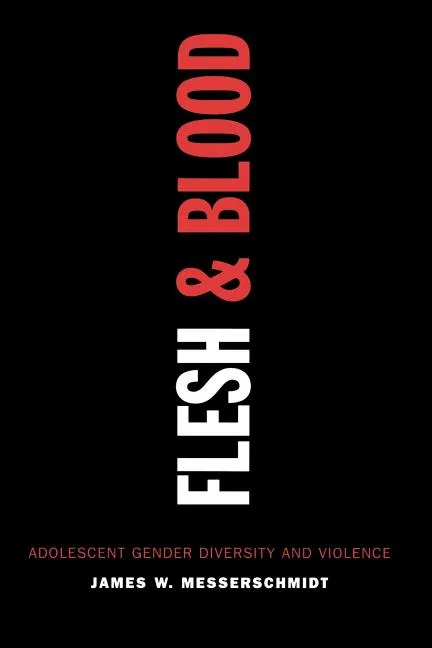
Sociologists and criminologists have long known that there is a relationship between masculinity and crime. Indeed, gender has been advanced consistently as the strongest predictor of criminal involvement. Flesh and Blood provides a fascinating account of the connection among adolescent gender diversity, the body, and assaultive violence. The book is divided into four parts. In Part I, the author explores the history of criminology as a discipline, paying particular attention to the misgivings about the body, gender, and crime. Messerschmidt shows that criminology historically has maintained, in various ways, the mind-body, sex-gender, and gender difference binaries. In Part II, Messerschmidt presents a theoretical framework-structured action theory-for overcoming these binaries. This perspective allows conceptualization of: embodiment as a lived aspect of gender, both gender differences and gender similarities in the commission of crime, how embodied social action is embedded in specific structural gender relations in particular settings, and how embodied social actions may be related to violence and nonviolence. The methodology for the study is also presented in Part II, which seeks to understand, through life-history interviews, certain boys' and girls' use of assaultive violence as a gendered practice. Part III presents in depth life histories of four white working-class boys and girls involved in assaultive violence. The two chief questions addressed in these life stories are: Why is it that some boys and some girls engage in assaultive violence and how are these violent boys and girls similar and different? How are gender relations in specific settings-such as the family, the school, and the street-related to motivation for embodied violence and nonviolence by the same boys and girls? Part IV puts structured action theory to work by analyzing the three major sites (home, school, and street) of the boys' and girls' life histories and how these are related to assaultive violence and nonviolence.
James W. Messerschmidt
James W. Messerschmidt is Professor
of Sociology and Women's and Gender Studies at the University of Southern
Maine. His research has covered such diverse areas as gender and
crime/violence, genderqueers, intersectionality, and global political
masculinities. Messerschmidt is the author of a number of books, including Gender, Heterosexuality, and Youth Violence:
The Struggle for Recognition and, most recently, Masculinities in the Making: From the Local to the Global.
James W. Messerschmidt is Professor of Sociology and Women's and Gender Studies at the University of Southern Maine. His research has covered such diverse areas as gender and crime/violence, genderqueers, intersectionality, and global political masculinities. Messerschmidt is the author of a number of books, including Gender, Heterosexuality, and Youth Violence: The Struggle for Recognition and, most recently, Masculinities in the Making: From the Local to the Global.
More by James W. Messerschmidt


Why Readwise Books?
Readwise Books is an ebook & audiobook platform that automatically logs how much you and your friends read, making it fun and easy to read more. Learn more →