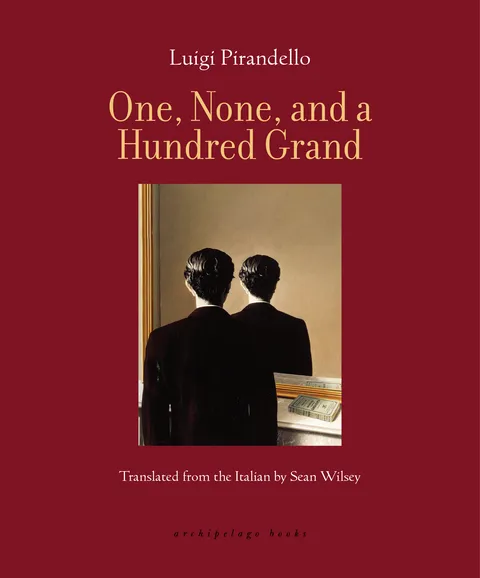
One, None, and a Hundred Grand
Report an issue
Tell us what's wrong and we'll take a look.
Thanks – we got it. We'll review and follow up if needed.
A hilarious exploration of the relativism of identity from Italian novelist and playwright Luigi Pirandello, winner of the 1934 Nobel Prize in Literature.
This uproarious new translation of One, None, and a Hundred Grand delivers the defining work of Italian existentialism to an English speaking audience—in all its madcap glory. The novel’s hero is a wealthy twenty-four-year-old naïf who considers himself “a regular guy,” despite being cursed at birth with a surname that’s “ugly to the point of cruelty: Maggot. Destined to become a fly, with its sour, spiteful, annoying drone.” The story tracks Maggot’s reaction to an offhand act of matrimonial malice. Was he aware that his nose leans to the right? He is struck by the full force of the fact that he does not, and cannot, know how others see him. So he sets out on a quest “to coax forth the many Maggots living inside my closest companions, and destroy them one by one.” It’s a premise, played straight, that acts as an inspired metaphor for the rightward-leaning madness of the 20th century, and a catalyst for a series of absurd scenarios and comic set pieces on par with the very best of 21st century observational comedy—imagine Curb Your Enthusiasm in fascist Sicily. Pirandello splits the atom of the self and detonates a tiny moment into “a catastrophe that supervened the very machinery of the cosmos.” Perception and identity are leveled in a literary performance the Nobel laureate regarded as a “complete synthesis of everything I have done and the wellspring of what I will go on to do.”
Luigi Pirandello
Luigi Pirandello was an influential Italian dramatist, novelist, poet, and short story writer, best known for his pioneering work in the theater. Born on June 28, 1867, in Agrigento, Italy, Pirandello's writing was deeply influential in the realm of modern drama. His works often explored complex themes such as the nature of identity, the relationship between reality and illusion, and the blurred boundaries between art and life. Pirandello's distinctive approach to theater and narrative earned him the 1934 Nobel Prize in Literature, awarded "for his bold and ingenious revival of dramatic and scenic art." He was married to Antonietta Portulano, with whom he had three children: Stefano, Fausto, and Lietta. Pirandello's legacy extends beyond literature, with his works inspiring numerous film adaptations, including Kaos and The Former Mattia Pascal. He passed away on December 10, 1936, in Rome, at the age of 69. Pirandello's profound influence on theater continues to resonate today, with his exploration of existential questions and theatrical experimentation leaving a lasting mark on the field.
More by Luigi Pirandello



Sean Wilsey
Translated by
SEAN WILSEY, the author of a memoir, Oh the Glory of It All, and an essay collection, More Curious, is at work on a translation of Luigi Pirandello’s Uno, Nessuno e Centomila for Archipelago Books and a documentary film about 9/11, IX XI, featuring Roz Chast, Griffin Dunne, and many others (www.ixxi.nyc).


Why Readwise Books?
Readwise Books is an ebook & audiobook platform that automatically logs how much you and your friends read, making it fun and easy to read more. Learn more →