Knowledge and Self-Knowledge in Plato's Theaetetus
Report an issue
Tell us what's wrong and we'll take a look.
Thanks – we got it. We'll review and follow up if needed.
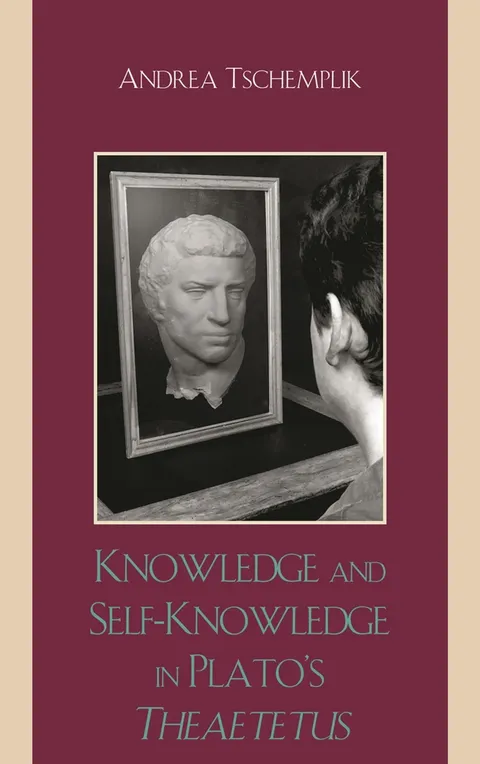
Knowledge and Self-Knowledge in Plato's Theaetetus advances a new explanation for the apparent failure of the Theaetetus to come to a satisfactory conclusion about the definition of knowledge. Tschemplik argues that understanding this aporetic dialogue in light of the fact that it was conducted with two noted mathematicians shows that for Plato, mathematics was not the paradigm for philosophy. She points out that, although mathematics is clearly an important part of the philosopher's training, as the educational outline of the Republic makes clear, the point on which the mathematician falls short is the central role that self-knowledge plays in philosophical investigation. Theaetetus betrays this deficiency and is led by Socrates to an understanding of the benefits of self-knowledge understood as the knowledge of ignorance. Tschemplik concludes that it is the absence of self-knowledge in the Theaetetus which leads to its closing impasse regarding knowledge.
This book will be of interest to scholars and graduate students in the history of philosophy with a special interest in ancient philosophy, and will also be accessible to upper-level undergraduates in ancient philosophy.
Andrea Tschemplik
Andrea Tschemplik is associate professor of philosophy and religion at American University and teaches a variety of courses in the history of philosophy, as well as thematic courses such as the philosophy of love and friendship. She is the author of Knowledge and Self-Knowledge in Plato's Theaetetus, the editor and translator of Plato, The Republic: The Comprehensive Student Edition, and the translator of published selections from Hegel's Phenomenology of Spirit.


Why Readwise Books?
Readwise Books is an ebook & audiobook platform that automatically logs how much you and your friends read, making it fun and easy to read more. Learn more →