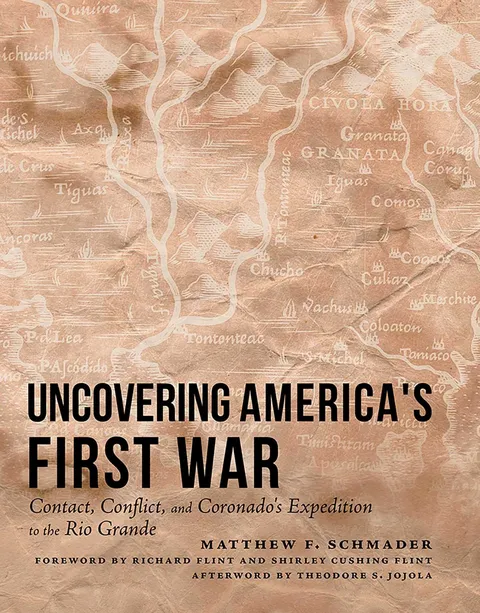
Uncovering America's First War
Contact, Conflict, and Coronado's Expedition to the Rio Grande
Report an issue
Tell us what's wrong and we'll take a look.
Thanks – we got it. We'll review and follow up if needed.
Winner of the 2026 Fray Francisco Atanasio Dominguez award from the Historical Society of New Mexico
By the 1530s, Indigenous Pueblo populations in the American Southwest reached tens of thousands of people with a rich culture expressed through stunning architecture, ceramic technology, and ceremonial life. Then, into that world came outsiders—an army from Spain’s new colony in Mexico led by Francisco Vázquez de Coronado. First contacts at the western Pueblos of Zuni, Hopi, and Acoma led to open warfare.
By the winter of 1540, increasing tensions and resistance spilled over into violence in America’s earliest named war, the Tiguex War, which occurred in an area settled by ancestors of today’s Rio Grande Pueblos. The largest and most intact battle site of that fierce conflict is known as Piedras Marcadas Pueblo, situated within present-day Albuquerque, New Mexico. Fighting back against Coronado’s crossbows and muskets with stone-tipped arrows and slingstones, the Puebloans mounted a courageous defense of their largest village, piling rocks on rooftops and hurling them down at attackers. Hundreds of artifacts found at Piedras Marcadas reveal the life-and-death contest for survival that occurred within those ancient walls and plazas.
Matthew F. Schmader
Matthew F. Schmader has been conducting archaeological research in central New Mexico for more than forty years. He has conducted research on sites of every major cultural time period in New Mexico and served as the Albuquerque City Archaeologist for ten years. He is currently an adjunct associate professor in the Department of Anthropology at the University of New Mexico.
More by Matthew F. Schmader


Why Readwise Books?
Readwise Books is an ebook & audiobook platform that automatically logs how much you and your friends read, making it fun and easy to read more. Learn more →