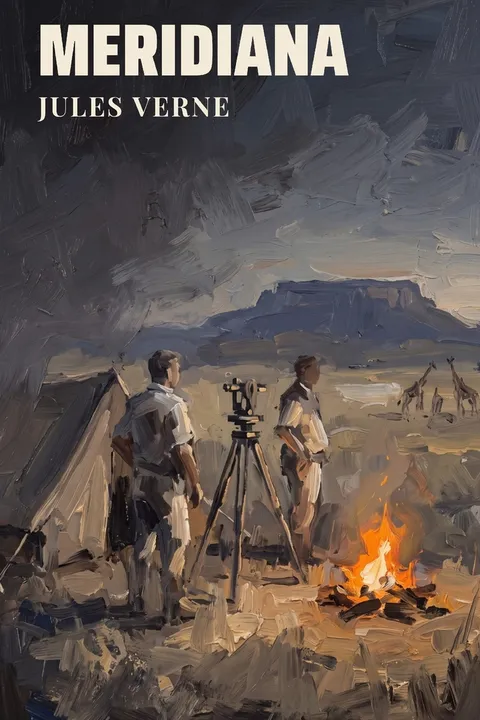
Meridiana (The Adventures of Three Englishmen and Three Russians in South Africa)
A New Translation in Modern Accessible English
Report an issue
Tell us what's wrong and we'll take a look.
Thanks – we got it. We'll review and follow up if needed.
The project is to measure an arc of the meridian across southern Africa - to take the precise angular measurements across hundreds of miles of Orange River territory and Kalahari Desert that will add another segment to the international geodetic survey of the Earth's exact shape and dimensions. The instruments are loaded, the calculations prepared, and the team assembled: three English surveyors and three Russians, led by Colonel Everest - named after the surveyor who mapped the Himalayas - and his Russian counterpart Mathieu Strux, who are equally skilled, equally devoted to the science, and constitutionally unable to agree on anything else.
Jules Verne published Meridiana in 1872, in the immediate aftermath of the Franco-Prussian War, and the Anglo-Russian rivalry at its center is not merely a plot device. Two great empires that have been competing for dominance across Central Asia have agreed, for the duration of a scientific expedition, to work together - and the agreement requires of each man a subordination of national feeling to shared purpose that the African landscape, the accumulated pressures of the survey, and the specific difficulty of working alongside an equal who happens to be a rival makes continuously and seriously hard. The novel is, among other things, a meditation on what European civilization was capable of when national pride was suspended in the service of shared knowledge.
It is also, with characteristic Vernian precision, a genuinely technical account of nineteenth-century geodetic practice: the triangulation from measured baselines, the theodolite observations, the chain of interconnected measurements that must be built with cumulative exactness across hundreds of miles of terrain that has no interest in the precision required of it. Verne had done his research, and the science is right, and the drama of the science - the specific drama of work that must be perfect or it is worthless, conducted in conditions that make perfection continuously, specifically, and inventively difficult - is the drama the novel delivers.
One of the most formally austere and most politically serious of the Voyages extraordinaires - and the one that trusts the science, most completely, to carry the story.
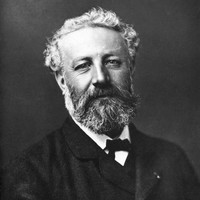
Jules Verne
Jules Verne (1828-1905) is considered by many the father of science fiction. Born in Nantes, France, he studied law but turned to writing opera libretti until the 1863 publication of Five Weeks in a Balloon, the first of his Extraordinary Voyages series. Its success encouraged him to produce a number of classic and prophetic science fiction novels, including Journey to the Center of the Earth and Twenty Thousand Leagues under the Sea. His stories foresaw many scientific and technological developments, including the submarine, television, and space travel.
More by Jules Verne



Why Readwise Books?
Readwise Books is an ebook & audiobook platform that automatically logs how much you and your friends read, making it fun and easy to read more. Learn more →