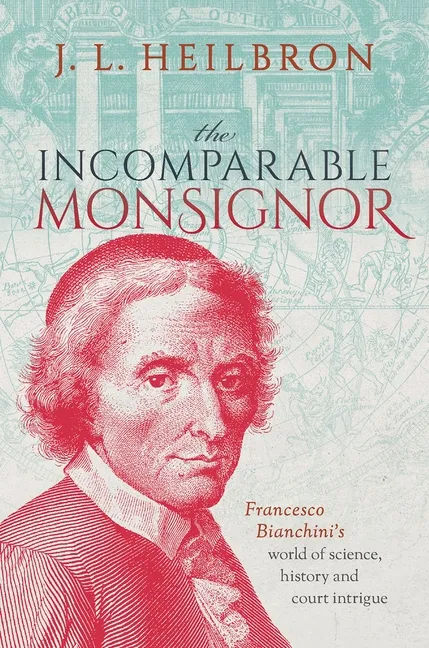
The Incomparable Monsignor
Francesco Bianchini's World of Science, History, and Court Intrigue
Report an issue
Tell us what's wrong and we'll take a look.
Thanks – we got it. We'll review and follow up if needed.
Born in a time where entry into the church granted power, privilege, and access to the most exciting ideas of his time, the magnificent Monsignor Francesco Bianchini was an accomplished player in the political, scientific, and historical arenas of early modern Europe. Among his accomplishments were writing a universal history from the creation to the fall of Assyria; discovering, excavating, and interpreting ancient buildings; and designing a papal collection of antiquities that was later partially realized in the Vatican museums. He was also responsible for confirming and publicizing Newton's theories of light and color; discovering several comets; and building the most beautiful and exact heliometer in the world in the basilica of Santa Maria degli Angeli in Rome.
Bianchini's international reputation earned him election to the Académie royale des sciences of Paris and the Royal Society of London. As a trusted servant of Pope Clement XI, he helped to execute the difficult balancing act the papacy practiced during the War of the Spanish Succession, which pitted Britain, the Dutch Republic, and the Habsburg Empire against France and Spain. One of his assignments also resulted in attachment to the cause and person of the Old Pretender, James III, the Stuart claimant to the thrones of England, Scotland, and Ireland. Through the career of this eminent and adept diplomat, astronomer, archaeologist, and historian, J. L. Heilbron introduces a world of learning and discovery, Church and State, and politics and power.
J L Heilbron
J. L. Heilbron was educated at the University of California, Berkeley, in physics and history and began teaching at the University of Pennsylvania in 1964. He returned to Berkeley in 1967, where he rose to become professor of history and vice chancellor. After retiring in 1994 Heilbron taught sporadically at Caltech and Yale, and lived mostly around Oxford, where he has been Senior Research Fellow at Worcester College and the Oxford Museum for History of Science. He has written several books, including Galileo and Love, Literature, and the Quantum Atom: Niels Bohr's 1913 Trilogy Revisited, with Finn Aaserud.
More by J L Heilbron












Why Readwise Books?
Readwise Books is an ebook & audiobook platform that automatically logs how much you and your friends read, making it fun and easy to read more. Learn more →