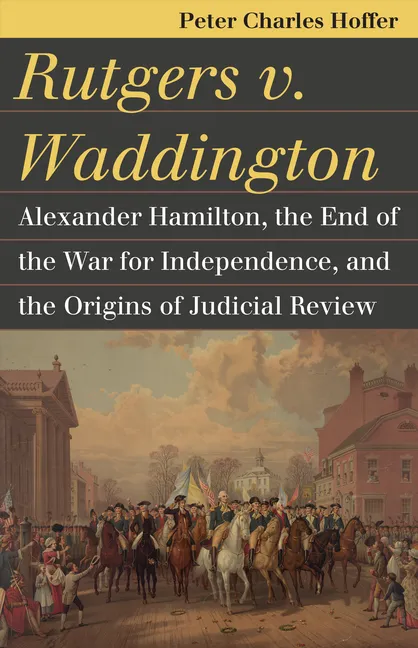
Rutgers V. Waddington
Alexander Hamilton, the End of the War for Independence, and the Origins of Judicial Review
Report an issue
Tell us what's wrong and we'll take a look.
Thanks – we got it. We'll review and follow up if needed.
At the end of the Revolution, the widow Rutgers and her sons returned to the brewery they'd abandoned when the British had occupied New York. They demanded rent from Waddington, the loyalist who had rented the facility under the British occupation. Under a punitive New York state law, the loyalist Waddington was liable. But the peace treaty's provisions protecting loyalists' property rights said otherwise. Appearing for the defendants was war veteran, future Federalist, and first secretary of the treasury, Alexander Hamilton. And, as always, lurking in the background was the estimable Aaron Burr. As Hoffer details Hamilton's arguments for the supremacy of treaty law over state law, the significance of Rutgers v. Waddington in the development of a strong central government emerges clearly--as does the role of the courts in bridging the young nation's divisions in the Revolution's wake.
Rutgers v. Waddington illustrates a foundational moment in American history. As such, it is an encapsulation of a society riven by war, buffeted by revolutionary change attempting to piece together the true meaning of, in John Adams' formulation, "rule by law, and not by men."
Peter Charles Hoffer
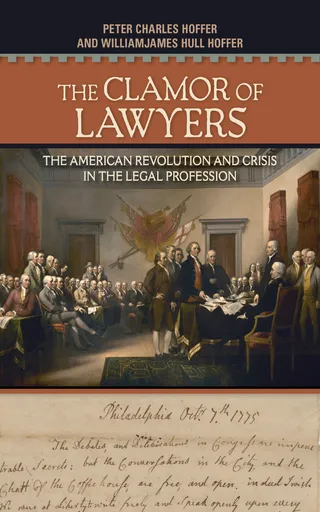
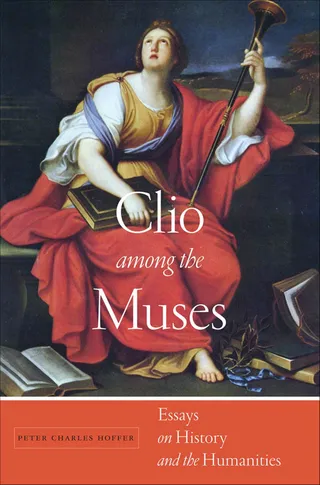
Peter Charles Hoffer is Distinguished Research Professor of History at the University of Georgia. He has authored and co-authored more than twenty books, including Clio Among the Muses: Essays on History and the Humanities; The Historians' Paradox: The Study of History in Our Time; and The Clamor of Lawyers: The American Revolution and the Crisis in the Legal Profession.
More by Peter Charles Hoffer



Why Readwise Books?
Readwise Books is an ebook & audiobook platform that automatically logs how much you and your friends read, making it fun and easy to read more. Learn more →