Report an issue
Tell us what's wrong and we'll take a look.
Thanks – we got it. We'll review and follow up if needed.
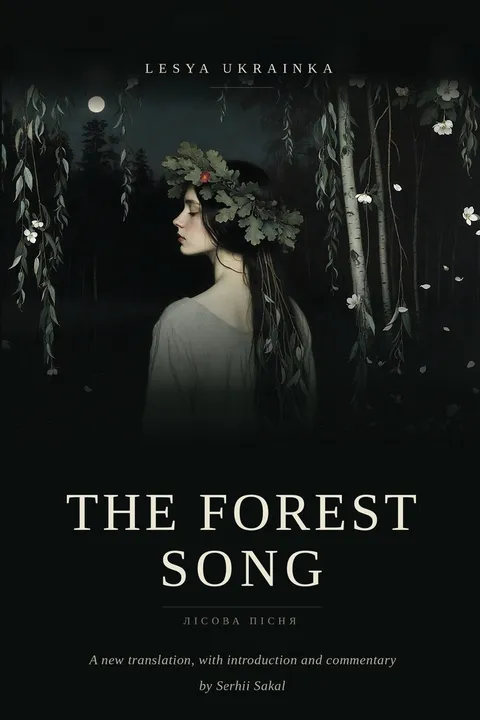
In the summer of 1911, Lesya Ukrainka was living in Georgia, four hundred miles from anywhere she had ever called home, ill with the tuberculosis that would kill her two years later. In ten or twelve days she wrote a play set in a forest in Volhynia that she had not seen in years and would not see again. It became the best-loved work in Ukrainian literature.
The Forest Song opens on a lake in early spring, among beings who have lived there far longer than any village: Lisovyk, the old lord of the wood; Vodyanyk in his lake; Rusalka, who kills by laughter. Mavka wakes from her winter sleep to a sound she has never heard - a young man playing a pipe. She goes to find him.
What follows is not the fairy tale that setup promises. Lukash is an ordinary young man with a mother, a debt, and a field that needs cutting. Mavka comes to live in his house and is put to work. A widow from the next village arrives, capable and impatient and entirely reasonable, and the forest gives ground to the farm. The play's argument is not nature against civilisation. It is about what a person owes to the thing they have woken in someone else - and about what survives being betrayed.
Ukrainka called it a drama-feieriia, a drama-fairy play: flying spirits, transformations, a house on fire, and inside all that machinery a marriage, a mother-in-law, and a death.
This annotated edition is designed for readers coming to Ukrainian literature for the first time as well as for those who already know it. The Ukrainian names of the forest beings are kept rather than flattened into nymphs and goblins, and explained where they appear.
It includes:
- a new verse translation, in blank verse for the dialogue and rhyme where Ukrainka sings
- a translator's introduction on the play, its author, and the choices behind this English text
- footnotes throughout, kept light enough to read past
- a substantial back commentary, scene by scene, on symbolism, folklore, and the passages where the Ukrainian will not go quietly into English
- a glossary of the forest beings, with the Ukrainian terms
- a pronunciation guide
Translated from the Ukrainian by Serhii Sakal, whose previous translation is Taras Shevchenko's The Artist.
Lesia Ukrainka
Lesia Ukrainka (pen name of Larysa Kosach-Kvitka, 1879-1913) was one of the most prominent Ukrainian writers, poets, playwrights, literary scholars, and activists of the late nineteenth-early twentieth century. Along with Taras Shevchenko and Ivan Franko, she forms the triumvirate of Ukrainian national poets. Ukrainka was well-known for her feminist and progressive views, which found representation in her own works.
More by Lesia Ukrainka

Serhii Sakal
Translated by
Serhii Sakal was born in Ukraine in 1987 and lives in the United States. He read the Ukrainian classics at school, as everyone there does, and came back to them as an adult in a country where they had not been read. His previous translations are Taras Shevchenko's The Artist, Lesya Ukrainka's The Forest Song and The Boyar's Wife, Osyp Turiansky's Beyond the Limits of Pain, Volodymyr Vynnychenko's Notes of a Snub-Nosed Mephistopheles, Andrii Chaikovsky's After His Sister, and Ivan Franko's For the Hearth.He translated this one because it is the second Shevchenko novella in this series, and because a book written under an order forbidding its author to write deserves to be read in more languages than one.


Why Readwise Books?
Readwise Books is an ebook & audiobook platform that automatically logs how much you and your friends read, making it fun and easy to read more. Learn more →