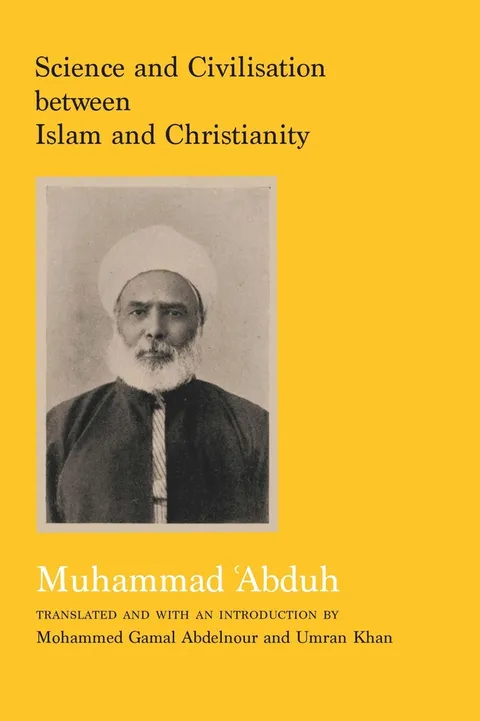
Science and Civilisation Between Islam and Christianity
Report an issue
Tell us what's wrong and we'll take a look.
Thanks – we got it. We'll review and follow up if needed.
This book is a translation of Muhammad Abduh's Al-Islam wa-l-Nasraniyya maa al-Ilm wa-l-Madaniyya (Science and Civilization between Islam and Christianity). Abduh was an Egyptian jurist, religious scholar, theologian, and reformer of Al-Azhar--Egypt's oldest university and a renowned seat of Islamic learning--who died in 1905. His impact on modern Islam cannot be overstated. In fact, much of modern Muslim thought has, in one way or another, been a reaction to his ideas. Although he is the subject of numerous English studies, only one treatise of his has been translated into English: Risalat al-tawhid (Theology of Unity) by Ishaq Masaad and Kenneth Cragg, in 1966.
Far too little attention has been paid to the treatise translated here and its impact on the Islamic theology of Christianity. This first English translation fills a serious gap in the genre of Islam and Christian-Muslim relations.
Muhammad Abduh
Muhammad Abduh (1849-1905) was a religious scholar, jurist, and liberal reformer, who led the late nineteenth-century movement in Egypt and other Muslim countries to revitalize Islamic teachings and institutions in the modern world. As mufti (Islamic legal counselor) for Egypt, he effected reforms in Islamic law, administration, and higher education and, although resisted by conservatives, broke the rigidity of Muslim ritual, dogma, and family ties. His writings include Treatise on the Oneness of God and a commentary on the Quran.
More by Muhammad Abduh
Umran Khan
Translated by
Umran Khan obtained a BA in Arabic and history from SOAS, University of London. He works as an Arabic-English translator, editor, and proofreader. He also writes on Islamic history and politics and teaches Arabic and Islamic history at the Hounslow Jamia Masjid & Islamic Centre. He is currently the program manager at Al-Salam Institute, London.


Why Readwise Books?
Readwise Books is an ebook & audiobook platform that automatically logs how much you and your friends read, making it fun and easy to read more. Learn more →