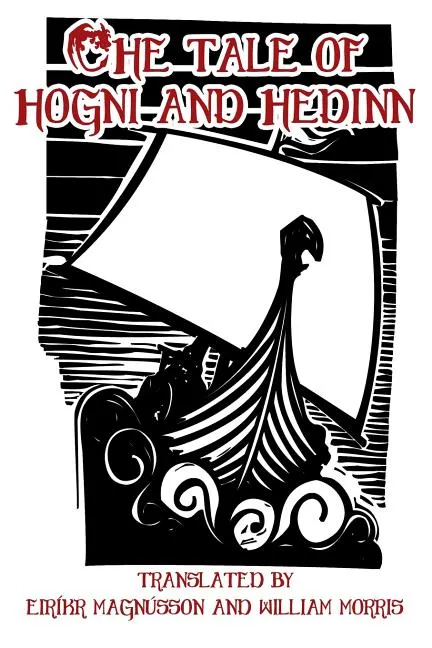
The Tale of Hogni and Hedinn
Report an issue
Tell us what's wrong and we'll take a look.
Thanks – we got it. We'll review and follow up if needed.
The Tale of Hogni and Hedinn, also known as Hjaðningavíg or the Saga of the Everlasting Battle, is an ancient Norse saga that recounts the tragic and legendary feud between two warriors, Hogni and Hedinn. This tale, as recounted by Eiríkr Magnússon in his translations of Icelandic sagas, is a classic example of the heroic and often brutal world of Norse mythology and literature.
The story revolves around a cursed, never-ending battle between the warriors and their armies, triggered by a betrayal involving Hogni's daughter. The saga is steeped in themes of honor, vengeance, and fate, reflecting the values and beliefs of the Norse people. The perpetual conflict is ultimately resolved only by the intervention of supernatural forces, illustrating the powerful influence of destiny in Norse lore.
Eirikr Magnusson
Translated by
Eiríkr, also known as Eiríkur Magnússon, was an Icelandic scholar at the University of Cambridge who taught William Morris Old Norse, collaborated with him on the translation of several Icelandic sagas into English, and was a key figure in the Victorian era movement to study the literature and history of the Norsemen. He lived from 1 February 1833 to 24 January 1913. Originally from Berufjörður in eastern Iceland, Eiríkr was brought to England in 1862 by the Icelandic Bible Society, where he began translating Christian books from the Middle Ages. He started working as an under-librarian at the Cambridge University Library in 1871, thanks to the support of Alexander Beresford Hope, MP for Cambridge, and Sir Henry Holland, 1st Baronet. He remained there until the end of 1909. William Morris was a British socialist organizer, poet, artist, fantasy writer, and textile designer who lived from March 24, 1834, to October 3, 1896. He was a part of the British Arts and Crafts movement. He made a big difference in bringing back traditional British textile skills and ways of making things. His writings helped create the modern fantasy genre, and in Great Britain at the end of the 1800s, he helped get people to accept socialism. Morris came from a rich middle-class family and was born in Walthamstow, Essex. Middle Ages had a big impact on him while he was studying classics at Oxford University and was a part of the Birmingham Set. After college, he married Jane Burden and became friendly with the Pre-Raphaelite artists Edward Burne-Jones and Dante Gabriel Rossetti, as well as the Neo-Gothic architect Philip Webb. Morris stayed in Red House in Kent from 1859 to 1865 before moving to Bloomsbury in central London. The house was designed by Webb and Morris. Morris started the decorative arts company Morris, Marshall, Faulkner & Co. with Burne-Jones, Rossetti, Webb, and others in 1861. It quickly became popular and in high demand. During the Victorian era, Morris designed textiles, wallpaper, fabrics, furniture, and stained glass windows, all of which had a big impact on interior design.


Why Readwise Books?
Readwise Books is an ebook & audiobook platform that automatically logs how much you and your friends read, making it fun and easy to read more. Learn more →