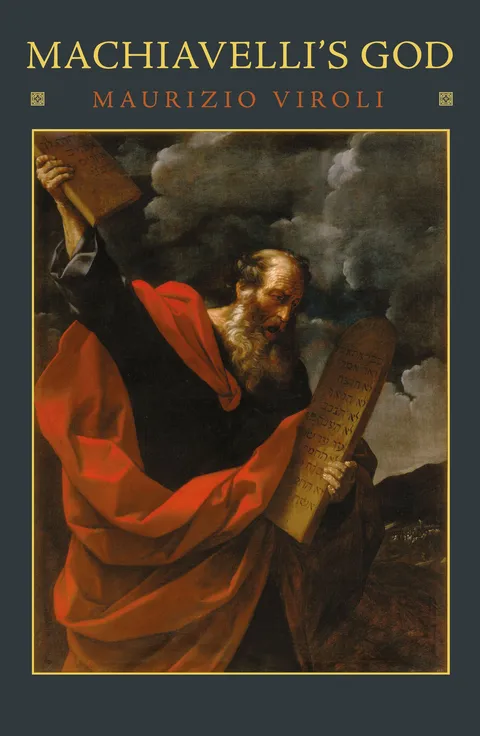
Machiavelli's God
Report an issue
Tell us what's wrong and we'll take a look.
Thanks – we got it. We'll review and follow up if needed.
How Machiavelli's Christianity shaped his political thought
To many readers of The Prince, Machiavelli appears to be deeply un-Christian or even anti-Christian, a cynic who thinks rulers should use religion only to keep their subjects in check. But in Machiavelli's God, Maurizio Viroli, one of the world's leading authorities on Machiavelli, argues that Machiavelli, far from opposing Christianity, thought it was crucial to republican social and political renewal—but that first it needed to be renewed itself. And without understanding this, Viroli contends, it is impossible to comprehend Machiavelli's thought.
Viroli places Machiavelli in the context of Florence's republican Christianity, which was founded on the idea that the true Christian is a citizen who serves the common good. In this tradition, God participates in human affairs, supports and rewards those who govern justly, and desires men to make the earthly city similar to the divine one. Building on this tradition, Machiavelli advocated a religion of virtue, and he believed that, without this faith, free republics could not be established, defend themselves against corruption, or survive. Viroli makes a powerful case that Machiavelli, far from being a pagan or atheist, was a prophet of a true religion of liberty, a way of moral and political living that would rediscover and pursue charity and justice.
The translation of this work has been funded by SEPS—Segretariato Europeo per le Pubblicazioni Scientifiche.

Antony Shugaar
Translated by
Antony Shugaar is a writer and translator. He is the author of Coast to Coast and I Lie for a Living and the coauthor, with Gianni Guadalupi, of Discovering America and Latitude Zero.








Why Readwise Books?
Readwise Books is an ebook & audiobook platform that automatically logs how much you and your friends read, making it fun and easy to read more. Learn more →