Report an issue
Tell us what's wrong and we'll take a look.
Thanks – we got it. We'll review and follow up if needed.
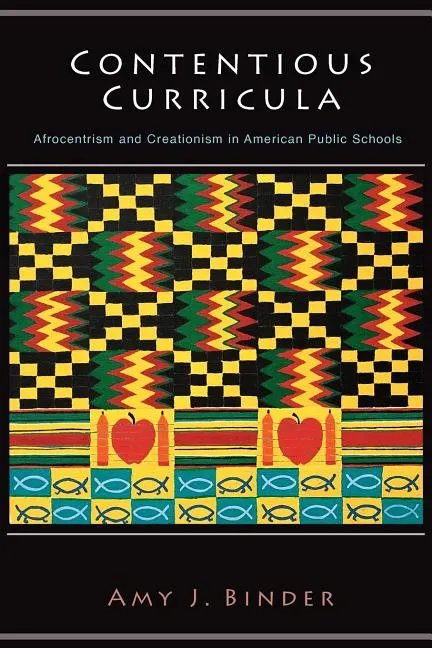
This book compares two challenges made to American public school curricula in the 1980s and 1990s. It identifies striking similarities between proponents of Afrocentrism and creationism, accounts for their differential outcomes, and draws important conclusions for the study of culture, organizations, and social movements.
Amy Binder gives a brief history of both movements and then describes how their challenges played out in seven school districts. Despite their very different constituencies--inner-city African American cultural essentialists and predominately white suburban Christian conservatives--Afrocentrists and creationists had much in common. Both made similar arguments about oppression and their children's well-being, both faced skepticism from educators about their factual claims, and both mounted their challenges through bureaucratic channels. In each case, challenged school systems were ultimately able to minimize or reject challengers' demands, but the process varied by case and type of challenge. Binder finds that Afrocentrists were more successful in advancing their cause than were creationists because they appeared to offer a solution to the real problem of urban school failure, met with more administrative sympathy toward their complaints of historic exclusion, sought to alter lower-prestige curricula (history, not science), and faced opponents who lacked a legal remedy comparable to the rule of church-state separation invoked by creationism's opponents.
Binder's analysis yields several lessons for social movements research, suggesting that researchers need to pay greater attention to how movements seek to influence bureaucratic decision making, often from within. It also demonstrates the benefits of examining discursive, structural, and institutional factors in concert.
Amy J Binder
Amy Binder is a professor at the University of California San Diego in the Department of Sociology. Amy Binder received her BA in Anthropology from Stanford University and her MA and PhD in Sociology from Northwestern University. Her principal research interests are in the areas of higher education, politics, cultural sociology, and organizations. One strand of her recent work focuses on the links between private universities and high-status first jobs, as exemplified in her award-winning article, "Career Funneling: How Elite Students Learn to Define and Desire 'Prestigious' Jobs" (in Sociology of Education, 2016). In other work, she has studied the influences of college campuses on students' political ideas, styles, and action. Her second book Becoming Right: How Campuses Shape Young Conservatives (Princeton University Press, 2013) established her reputation as an expert on political socialization and higher education, and her current research studying college students across the political spectrum will advance our understanding of millennial political actors. At UC San Diego, she has served as director of graduate studies for the Department of Sociology and was a founding member and organizer of an interdisciplinary workshop called The Workshop for the Study of Conservative Movements. From 2019-2022 she will serve as chair of the department. She has co-organized four UCSD Culture Conferences, resulting in a widely read special issue of The Annals of the American Academy of Political and Social Science. In other activities, Professor Binder served as the 2014-2015 Chair of the Sociology of Education section of the American Sociological Association, is a member of the Scholars Strategy Network, and recently completed a three-year term as deputy editor of the journal Sociology of Education. Professor Binder is a board member and chair of the Board Affairs Committee for The Preuss School, UC San Diego's award-winning charter middle and high school for first-generation college-goers.
More by Amy J Binder



Why Readwise Books?
Readwise Books is an ebook & audiobook platform that automatically logs how much you and your friends read, making it fun and easy to read more. Learn more →