Report an issue
Tell us what's wrong and we'll take a look.
Thanks – we got it. We'll review and follow up if needed.
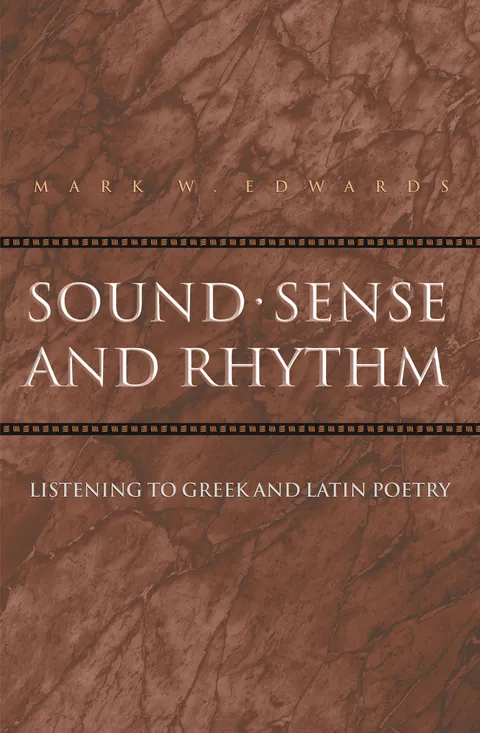
This book concerns the way we read--or rather, imagine we are listening to--ancient Greek and Latin poetry. Through clear and penetrating analysis Mark Edwards shows how an understanding of the effects of word order and meter is vital for appreciating the meaning of classical poetry, composed for listening audiences.
The first of four chapters examines Homer's emphasis of certain words by their positioning; a passage from the Iliad is analyzed, and a poem of Tennyson illustrates English parallels. The second considers Homer's techniques of disguising the break in the narrative when changing a scene's location or characters, to maintain his audience's attention. In the third we learn, partly through an English translation matching the rhythm, how Aeschylus chose and adapted meters to arouse listeners' emotions. The final chapter examines how Latin poets, particularly Propertius, infused their language with ambiguities and multiple meanings. An appendix examines the use of classical meters by twentieth-century American and English poets.
Based on the author's Martin Classical Lectures at Oberlin College in 1998, this book will enrich the appreciation of classicists and their students for the immense possibilities of the languages they read, translate, and teach. Since the Greek and Latin quotations are translated into English, it will also be welcomed by non-classicists as an aid to understanding the enormous influence of ancient Greek and Latin poetry on modern Western literature.
Mark Edwards
Professor Mark J. Edwards is Tutor in Theology at Christ Church College, Oxford. His previous publications include Catholicity and Heresy in the Early Church (2009), Image, Word and God in the Early Christian Centuries (2012) and Christians, Gnostics and Philosophers in Late Antiquity (2012)
More by Mark Edwards














Why Readwise Books?
Readwise Books is an ebook & audiobook platform that automatically logs how much you and your friends read, making it fun and easy to read more. Learn more →