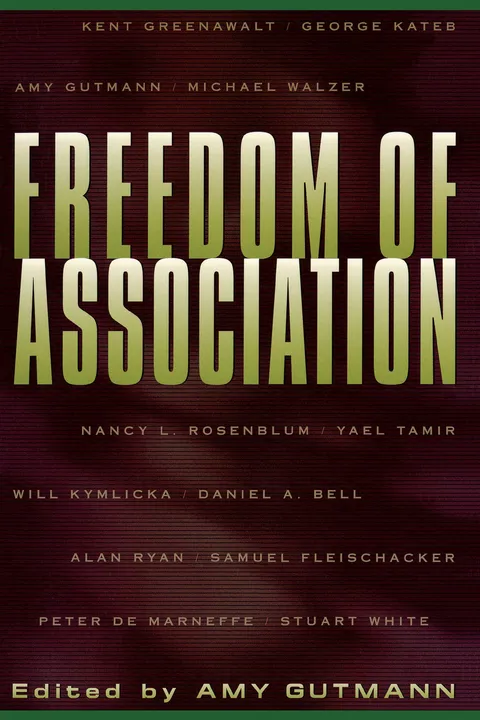
Freedom of Association
Report an issue
Tell us what's wrong and we'll take a look.
Thanks – we got it. We'll review and follow up if needed.
Americans are joiners. They are members of churches, fraternal and sororal orders, sports leagues, community centers, parent-teacher associations, professional associations, residential associations, literary societies, national and international charities, and service organizations of seemingly all sorts. Social scientists are engaged in a lively argument about whether decreasing proportions of Americans over the past several decades have been joining secondary associations, but no one disputes that freedom of association remains a fundamental personal and political value in the United States. "Nothing," Alexis de Tocqueville argued, "deserves more attention." Yet the value and limits of free association in the United States have not received the attention they deserve. Why is freedom of association valuable for the lives of individuals? What does it contribute to the life of a liberal democracy? This volume explores the individual and civic values of associational freedom in a liberal democracy, as well as the moral and constitutional limits of claims to associational freedom.
Beginning with an introductory essay on freedom of association by Amy Gutmann, the first part of this timely volume includes essays on individual rights of association by George Kateb, Michael Walzer, Kent Greenawalt, and Nancy Rosenblum, and the second part includes essays on civic values of association by Will Kymlicka, Yael Tamir, Daniel A. Bell, Sam Fleischacker, Alan Ryan, and Stuart White.




Why Readwise Books?
Readwise Books is an ebook & audiobook platform that automatically logs how much you and your friends read, making it fun and easy to read more. Learn more →