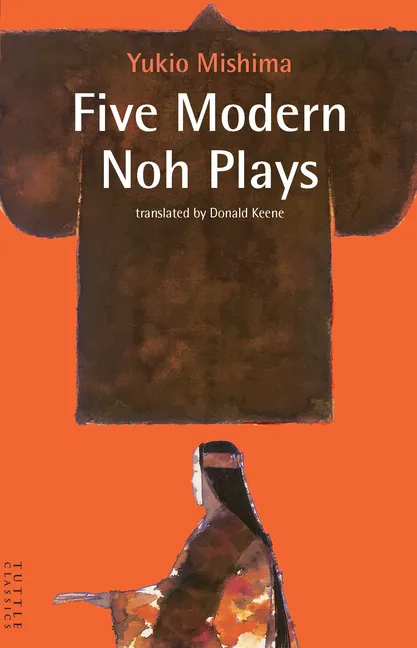
Five Modern Noh Plays
Report an issue
Tell us what's wrong and we'll take a look.
Thanks – we got it. We'll review and follow up if needed.
As long ago as 1916 William Butler Yeats and Ezra Pound were excitedly discovering Noh plays. In 1922 Arthur Waley's fine translations appeared in a collection titled The Noh Plays of Japan. Since then, interest has grown steadily in this unique art form.
At the heart of Noh lies the accidental encounter through which the workings of Fate are revealed. Often one of the persons is not what he or she seems to be: perhaps a ghost or a person fallen from high estate. Mishima has been marvelously successful in preserving the weird and haunting mood of classical Noh, but his characters and situations have the directness and hardness of an encounter on a city street.
The emotion of these plays is so communicable that one can imagine them staged anywhere in the world. Or they can be read and reread in Donald Keene's excellent translation.
Yukio Mishima
Yukio Mishima (1925-1970) completed his first novel the year he entered the University of Tokyo and his last novel the day of his death. He is the author of numerous novels, stories, plays, and essays. Gore Vidal once said of him: “I only regret we never met, for friends found him a good companion, a fine drinking partner, and fun to cruise with.” Mishima committed suicide by ceremonial seppuku after a failed coup d’e´tat intended to restore pre-WWII power to the emperor of Japan.
More by Yukio Mishima


Donald Keene
Translated by
Donald Keene, the author of dozens of books in both English and Japanese as well as the famed translator of Dazai, Kawabata, and Mishima, was the first non-Japanese to receive the Yomiuri Prize for Literature.


Why Readwise Books?
Readwise Books is an ebook & audiobook platform that automatically logs how much you and your friends read, making it fun and easy to read more. Learn more →