Report an issue
Tell us what's wrong and we'll take a look.
Thanks – we got it. We'll review and follow up if needed.
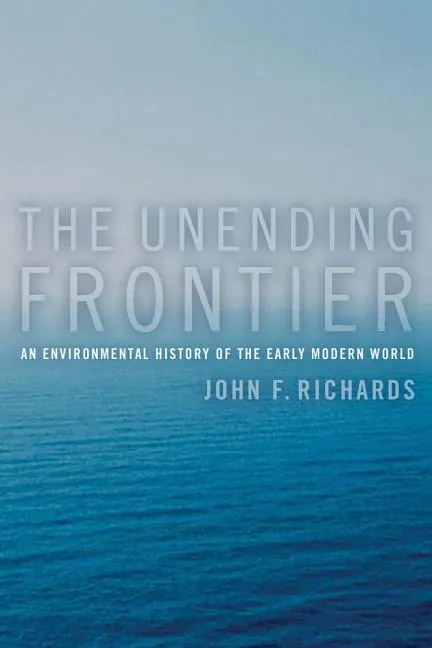
It was the age of exploration, the age of empire and conquest, and human beings were extending their reach--and their numbers--as never before. In the process, they were intervening in the world's natural environment in equally unprecedented and dramatic ways. A sweeping work of environmental history, The Unending Frontier offers a truly global perspective on the profound impact of humanity on the natural world in the early modern period.
John F. Richards identifies four broadly shared historical processes that speeded environmental change from roughly 1500 to 1800 c.e.: intensified human land use along settlement frontiers; biological invasions; commercial hunting of wildlife; and problems of energy scarcity. The Unending Frontier considers each of these trends in a series of case studies, sometimes of a particular place, such as Tokugawa Japan and early modern England and China, sometimes of a particular activity, such as the fur trade in North America and Russia, cod fishing in the North Atlantic, and whaling in the Arctic. Throughout, Richards shows how humans--whether clearing forests or draining wetlands, transporting bacteria, insects, and livestock; hunting species to extinction, or reshaping landscapes--altered the material well-being of the natural world along with their own.
John F. Richards
John Richards was Professor of History at Duke University and editor of Land, Property and the Environment (2001). He was also coeditor of World Deforestation in the Twentieth Century (1988) and Global Deforestation and the Nineteenth-Century World Economy (1983). He died in 2007.
John McNeill is professor of history at Georgetown University and author of several books on world and environmental history, most recently Mosquito Empires: Ecology and War in the Greater Caribbean, 1640-1914 (2010).
More by John F. Richards


Why Readwise Books?
Readwise Books is an ebook & audiobook platform that automatically logs how much you and your friends read, making it fun and easy to read more. Learn more →