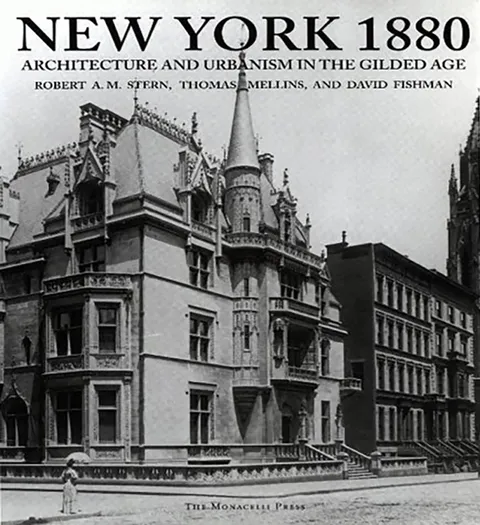
New York 1880
Architecture and Urbanism in the Gilded Age
Report an issue
Tell us what's wrong and we'll take a look.
Thanks – we got it. We'll review and follow up if needed.
This is the fourth volume in architect and historian Robert A. M. Stern's monumental series of documentary studies of New York City architecture and urbanism. The three previous books in the series, New York 1900, New York 1930, and New York 1960, have comprehensively covered the architects and urban planners who defined New York over the course of the twentieth century. In this volume, Stern turns back to 1880 -- the end of the Civil War, the beginning of European modernism -- to trace the earlier history of the city. This dynamic era saw the technological advances and acts of civic and private will that formed the identity of New York City as we know it today. The installation of water, telephone, and electricity infrastructures as well as the advent of electric lighting, the elevator, and mass transit allowed the city to grow both out and up. The office building and apartment house types were envisioned and defined, changing the ways that New Yorkers worked and lived. Such massive public projects as the Brooklyn Bridge and Central Park became realities, along with such private efforts as Grand Central Station. Like the other three volumes, New York 1880 is an in-depth presentation of the buildings and plans that transformed New York from a harbor town into a world-class metropolis. A broad range of primary sources -- critics and writers, architects, planners, city officials -- brings the time period to life and allows the city to tell its own complex story. The book is generously illustrated with over 1,200 archival photographs, which show the city as it was, and as some parts of it still are.
Robert A Stern
Dr. Robert Stern is Professor of Neurology, Neurosurgery, and Anatomy & Neurobiology at Boston University School of Medicine, where he is also Director of the Clinical Core of the BU Alzheimer's Disease Center, and Director of Clinical Research for the BU CTE Center. A major focus of his research involves the long-term effects of repetitive head impacts in athletes, including the neurodegenerative disease, chronic traumatic encephalopathy (CTE). He is the lead co-principal investigator of the DIAGNOSE CTE Research Project, a 7-year NIH-funded multi-center, longitudinal study to develop methods of diagnosing CTE during life as well as examining potential risk factors of the disease. Dr. Stern's other major area of funded research includes the diagnosis and treatment of Alzheimer's disease. He has also published on various aspects of cognitive assessment and is the senior author of many widely used neuropsychological tests. He has received numerous NIH and other national grants and he is a Fellow of both the American Neuropsychiatric Association and the National Academy of Neuropsychology.
More by Robert A Stern














Why Readwise Books?
Readwise Books is an ebook & audiobook platform that automatically logs how much you and your friends read, making it fun and easy to read more. Learn more →