Report an issue
Tell us what's wrong and we'll take a look.
Thanks – we got it. We'll review and follow up if needed.
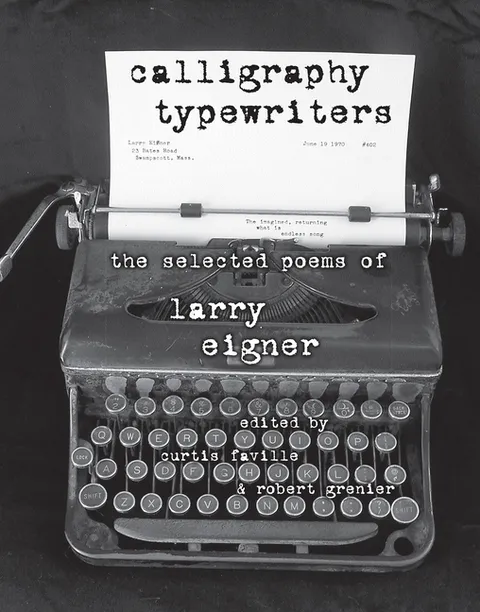
The first and only single-volume collection of Larry Eigner's most significant poems, gathering in one place the most celebrated of the several thousand poems that constitute his remarkable life's work
Larry Eigner began writing poetry at age eight and was first published at age nine. Revered by poets and artists across a broad spectrum of generations and schools, Eigner's remarkably moving poetry was created through enormous effort: because of severe physical disabilities, he produced his texts by typing with only one index finger and thumb on a 1940 Royal manual typewriter, creating a body of work that is unparalleled in its originality.
Calligraphy Typewriters showcases the most celebrated of Eigner's several thousand poems, which are an important part of the Black Mountain/Projectivist movement that began in the 1950s and which remain a primary inspiration for many younger writers, including those in the Language movement that began in the 1970s. In its two sections--Swampscott and Berkeley, named for the two locales where Eigner lived and worked--the volume traces his fantastic perception of the ordinary and his zeal for language. Eigner's use of visual space, metaphor, and description provide fascinating insights into both his own life and the world that surrounded him. This volume maintains the distinctive visual spacing of his original typescripts, reminders of his method, aesthetic sensibility, and creative ability to compose on the typewriter.
A collection that reimagines the ordinary, Calligraphy Typewriters is the definitive selection of Eigner's poems, and will serve well not only poets and students of poetry, but readers and writers of every vein.
Larry Eigner
Critically palsied as a result of forceps delivery at birth, Larry Eigner has spent most of his life in bed or in a wheelchair. Until 1978 he lived with his family in Massachusetts, but then moved to Berkeley, California, where he was cared for by the poet Robert Grenier. The example of William Carlos Williams can be felt in Eigner's attention to detail and precision of observation. His work characteristically derives from sights and sounds in the vicinity of his home--clouds, birds, crickets, cars, rain--but words in the poems are arranged in visual patterns of great elegance and complexity, much as in the work of one of his principal masters, Charles Olson. Eigner does not merely duplicate Olson's projectivist manner, however. In Ron Silliman's introduction to his anthology of Language Poetry, IN THE AMERICAN TREE--dedicated to Eigner--he identifies this poet as one who has `transcended the problematic constraints' of Olson's speech-based projectivist poetics. Eigner has himself pointed out that his poetry originates in thinking rather than speech. Eigner's Selected Poems was published in 1972, his selected prose, COUNTRY/HARBOR/QUIET/ACT/AROUND, in 1978. Among many subsequent poetry collections are Things Stirring Together or Far Away, READINESS/ENOUGH/DEPENDS/ON, and Waters, Places, a Time. His critical writings were edited by Benjamin Friedlander in AREAS LIGHTS HEIGHTS: WRITINGS 1954-1989. An earlier selection is Quiet Harbor Quiet Act Around. Some of his letters were gathered by Robert Kocik and Joseph Simas in Larry Eigner Letters.
More by Larry Eigner


Why Readwise Books?
Readwise Books is an ebook & audiobook platform that automatically logs how much you and your friends read, making it fun and easy to read more. Learn more →