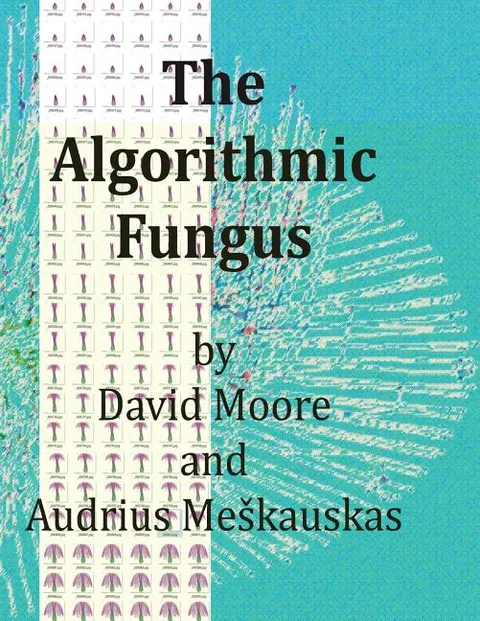
The Algorithmic Fungus
Report an issue
Tell us what's wrong and we'll take a look.
Thanks – we got it. We'll review and follow up if needed.
This book describes our package of interactive computer models that simulate the way filamentous fungal hyphae grow in three-dimensional space. We call it the Neighbour-Sensing mathematical model of hyphal growth. This three-dimensional mathematical model of hyphal growth was developed to study the morphogenesis of fungal hyphal networks. The apps that make up the modelling program allow the user to change the intimate characteristics of the growing cyberfungus. Aspects like the amount of branching, angle of branching and whether cyberhyphal threads stay together or grow apart (among several other features) can all be changed to establish their effect on the way the simulated cyberhyphae grow. So, the programs provide the user with a way to experiment with virtual fungi 'growing' in his/her computing device. It is the ultimate, most controllable, and most life-like cyberfungus you can have on your own computer; it is an experimental tool, not a game or a painting program. It provides the scientist in YOU with a way of experimenting with features that may regulate hyphal growth patterns to arrive at suggestions that could be tested with live fungi. The Neighbour-Sensing model explains how various cyberfungal structures may arise because of the 'crowd behaviour' of the community of cyberhyphal tips that make up the cybermycelium. And it does this by demonstrating the behaviour on your computer monitor. We show you how you can make the programs generate structures that mimic all sorts of fungal fruiting structures: conidiophores, sclerotia, the open more-or-less saucer-shaped or cup-like apothecia of discomycete Ascomycota, closed cleistothecial ascoma or hypogeous fruit bodies of the truffles and their allies, the perithecial flask-shaped or bottle-like ascomata of pyrenomycete Ascomycota, as well as different sorts of mushroom-like fruit bodies characteristic of the Basidiomycota. The whole Kingdom is open to you for experimentation! In these pages, we present a complete outline of the science and mathematics that underpin the Neighbour-Sensing model of cyberhyphal growth and show a wide range of experiments done with the model. More than this, we show you how to download the freeware programs to your own computer, and provide all the documentation you will need to experience the program and carry out experiments with cyberfungi for yourself.
David Moore
DAVID MOORE graduated from Duke University and served for more than twenty-five years as a US Air Force officer and fighter pilot. He's flown both the A-10 "Warthog" and the F-117 "Nighthawk" stealth fighter, deploying around the world to more than fifteen countries, including flying combat missions in Serbia during Operation Allied Force. David's career has taken him from fighter cockpits to the Pentagon and the White House.
Following his military career, David worked in the defense industry and later as the executive director of the White House Fellows alumni association.
David is married to Dr. Stefanie Sanford and has three grown children and two grandsons. Have Blue Sky is David's debut novel.
More by David Moore













Why Readwise Books?
Readwise Books is an ebook & audiobook platform that automatically logs how much you and your friends read, making it fun and easy to read more. Learn more →