Hegel's Logic: Being Part One of the Encyclopaedia of the Philosophical Sciences
Report an issue
Tell us what's wrong and we'll take a look.
Thanks – we got it. We'll review and follow up if needed.
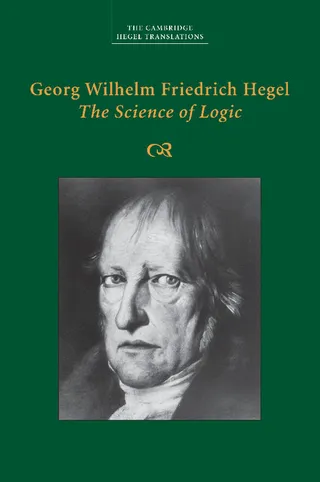
A major figure in German Idealism, early 19th century philosopher G. W. F. Hegel developed a comprehensive philosophical framework, referred to as "Absolute Idealism" which sought to describe the relation between mind and nature. Underpinning the framework of this philosophy is the assertion that in order for the human consciousness to understand the world at all there must be in some sense an identity of thought and being. "Hegel's Logic" or part one of the "Encyclopedia of the Philosophical Sciences" is an abbreviation of Hegel's earlier "Science of Logic". It is a work in which Hegel presents the categories of thought as they are in themselves; they are the minimal conditions for thinking anything at all, the conceptions that run in the background of all our thinking. In Hegel's philosophy no amount of observing will bring us to the essence of things, instead it is the articulation of the "Geist", or spirit, in other words, the activity of thinking, that gives definition to the nature of existence. The analysis of Hegel's philosophy often results in contradictory interpretations which is illustrative of the complexity of his works as he wrote with the assumption that the reader was well versed in the works of philosophy that came before. Hegel wrote the "Encyclopedia of the Philosophical Sciences" with the intention of it being a more accessible entry point to his philosophy.
G. W. F. Hegel
Georg Wilhelm Friedrich Hegel was born on August 27, 1770, in Stuttgart, Germany, to parents Georg Ludwig Hegel and Maria Magdalena Louisa Fromm. He became a central figure in 19th-century German philosophy, known for his work in idealism. Hegel's thought spanned a wide array of subjects, including epistemology, metaphysics, political theory, aesthetics, and the philosophy of religion. He advanced a dialectical method that examined the evolution of ideas through contradiction and resolution, significantly shaping how later thinkers approached history, consciousness, and social systems. His work emphasized that reality and rationality are deeply intertwined, and he presented history as a rational process marked by the unfolding of human freedom. Hegel's writings on aesthetics elevated art as a vehicle of truth and spirit. His influence touched numerous later philosophers such as Martin Heidegger, Ludwig Feuerbach, and Michel Foucault. In 1811, he married Marie Helena Susanna von Tucher, and they had three children. Hegel died on November 14, 1831, in Berlin, leaving a legacy that continues to provoke debate and inspire study.
More by G. W. F. Hegel


Why Readwise Books?
Readwise Books is an ebook & audiobook platform that automatically logs how much you and your friends read, making it fun and easy to read more. Learn more →