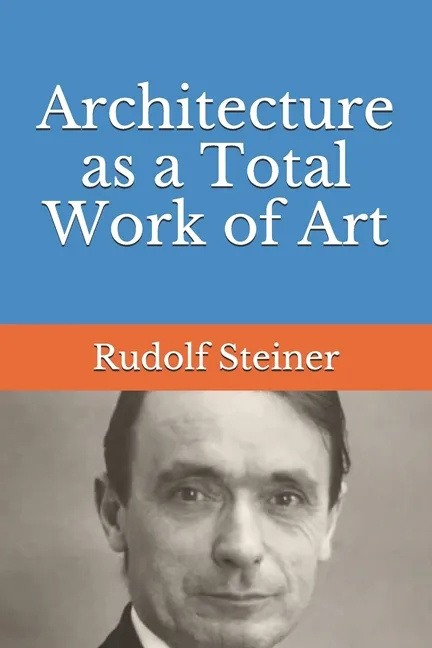
Architecture as a Total Work of Art
Report an issue
Tell us what's wrong and we'll take a look.
Thanks – we got it. We'll review and follow up if needed.
Heinrich Ferstel said that architectural styles are not invented, but born out of the spiritual life of an entire age. Steiner agrees wholeheartedly with this statement, but then asks: Why does his age only recapitulate old styles? Why is it impotent to create a new style? The Goetheanum was meant to be a new impulse out of the clarity of anthroposophical striving. Like the Mystery Dramas, this new architectural impulse will contribute simultaneously to social renewal.The Goetheanum was meant to be real art, not abstraction. It was not meant to capture the ideas of anthroposophy in symbolic form, but rather to be another branch growing from the same root as anthroposophy. The head and the body need to be sculpted very differently. Color nuances should supersede line; we need to create out of color itself. Form should be the work of color.In the Goetheanum, two spaces represent human striving and the answer to that striving. The infinite sphere arrives as a new architectural form. Sculpting in wood is very different from sculpting in stone: in the former we need to carve out concavities, while in the latter we need to build up convexities. Evolution does not yield ever greater complexity; instead, it runs from the simple to the complex and then back to simplicity again. Everything in the building is organic. The old dynamic-mechanical principle of architecture gives way to Goethean metamorphosis.
Rudolf Steiner
Rudolf Steiner (1861-1925) was born in the small village of Kraljevec, Austro-Hungarian Empire (now in Croatia), where he grew up. As a young man, he lived in Weimar and Berlin, where he became a well-published scientific, literary, and philosophical scholar, known especially for his work with Goethe's scientific writings. At the beginning of the twentieth century, he began to develop his early philosophical principles into an approach to systematic research into psychological and spiritual phenomena. Formally beginning his spiritual teaching career under the auspices of the Theosophical Society, Steiner came to use the term Anthroposophy (and spiritual science) for his philosophy, spiritual research, and findings. The influence of Steiner's multifaceted genius has led to innovative and holistic approaches in medicine, various therapies, philosophy, religious renewal, Waldorf education, education for special needs, threefold economics, biodynamic agriculture, Goethean science, architecture, and the arts of drama, speech, and eurythmy. In 1924, Rudolf Steiner founded the General Anthroposophical Society, which today has branches throughout the world. He died in Dornach, Switzerland.
More by Rudolf Steiner



Why Readwise Books?
Readwise Books is an ebook & audiobook platform that automatically logs how much you and your friends read, making it fun and easy to read more. Learn more →