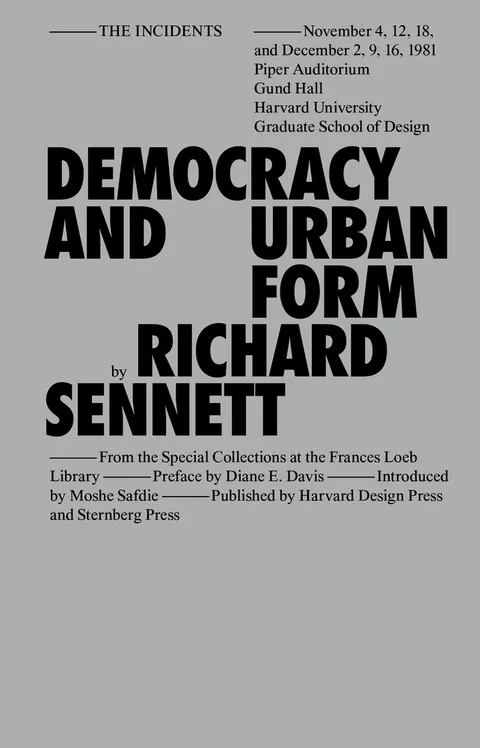
Democracy and Urban Form
Report an issue
Tell us what's wrong and we'll take a look.
Thanks – we got it. We'll review and follow up if needed.
"Never have the potential political consequences of architecture been greater, and never has the political sensibility of architecture been less."
This was the state of the discipline that social theorist and urban thinker Richard Sennett declared when he addressed an audience at the Harvard University Graduate School of Design in 1981. Over a series of six lectures, Sennett presented discourse as the foundation of democracy, and posited that our cities are uniquely positioned to either empower or constrict this discourse--and that the difference could lie in architecture and urban design.
Now, over 40 years later, as political polarization persists and its consequences arise in both new and familiar ways, Democracy and Urban Form revisits questions that remain relevant: If discourse is the foundation of democracy, how can the design of our cities empower and enable discourse?
Richard Sennett
Richard Sennett is one of the world's most highly distintguished urban thinkers and planners. His previous books include The Fall of Public Man, Flesh and Stone and Respect, as well as the recent Homo Faber trilogy, The Craftsman, Together, Building and Dwellings. For decades he has advised urban programmes for the United Nations. He has been awarded the Hegel and Spinoza prizes, as well as an honorary doctorate by Cambridge University.
More by Richard Sennett


Why Readwise Books?
Readwise Books is an ebook & audiobook platform that automatically logs how much you and your friends read, making it fun and easy to read more. Learn more →