Report an issue
Tell us what's wrong and we'll take a look.
Thanks – we got it. We'll review and follow up if needed.
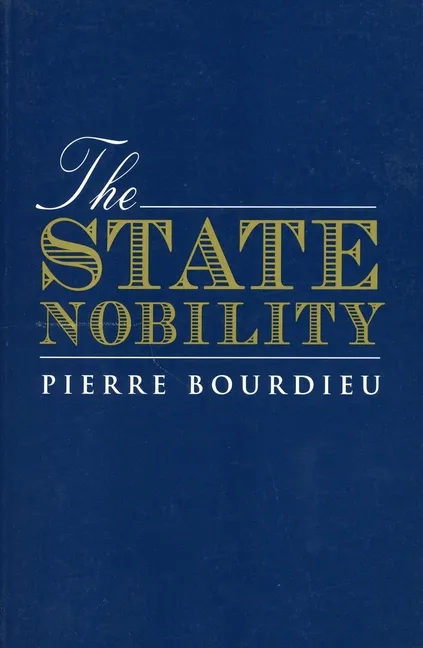
In this major new work, Pierre Bourdieu examines the distinctive forms of power--political, intellectual, bureaucratic, and economic--by means of which contemporary societies are governed. What kinds of competence are claimed by the bureaucrats and technocrats who govern us? And how do those who govern gain our recognition and acquiescence?
Bourdieu examines in detail the work of consecration that is carried out by elite education systems--in France by the grande écoles, in the United States by the Ivy League schools, and in England by Oxford and Cambridge. Today, this "state nobility" has at its disposal an unprecedented range of powers and distinctive titles to justify its privilege. Bourdieu shows how it is the heir--structural and sometimes genealogical--of the noblesse de robe, which, in order to consolidate its position in relation to other forms of power, had to construct the modern state and the republican myths, meritocracy, and civil service that went along with it.
Combining ethnographic description, historical documentation, statistical analysis, and theoretical argument, Bourdieu develops a wide-ranging and highly original account of the forms of power and governance that have come to prevail in our society today.
Pierre Bourdieu
Pierre Bourdieu (1930-2002) was Professor of Sociology at the Coll�ge de France and Director of Studies at the Ecole des Hautes Etudes en Sciences Sociales. He was the author of many books, most notably Distinction, The Rules of Art, The State Nobility, Homo Academicus, The Logic of Practice, and The Weight of the World.
More by Pierre Bourdieu



Why Readwise Books?
Readwise Books is an ebook & audiobook platform that automatically logs how much you and your friends read, making it fun and easy to read more. Learn more →