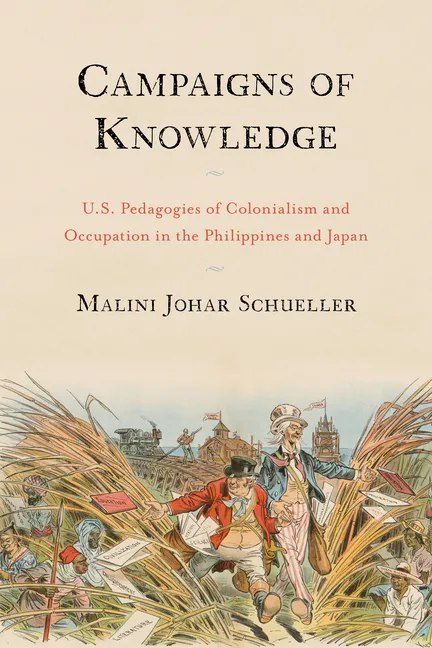
Campaigns of Knowledge
U.S. Pedagogies of Colonialism and Occupation in the Philippines and Japan
Report an issue
Tell us what's wrong and we'll take a look.
Thanks – we got it. We'll review and follow up if needed.
The creation of a new school system in the Philippines in 1898 and educational reforms in occupied Japan, both with stated goals of democratization, speaks to a singular vision of America as savior, following its politics of violence with benevolent recuperation. The pedagogy of recovery-in which schooling was central and natives were forced to accept empire through education-might have shown how Americans could be good occupiers, but it also created projects of Orientalist racial management: Filipinos had to be educated and civilized, while the Japanese had to be reeducated and "de-civilized."
In Campaigns of Knowledge, Malini Schueller contrapuntally reads state-sanctioned proclamations, educational agendas, and school textbooks alongside political cartoons, novels, short stories, and films to demonstrate how the U.S. tutelary project was rerouted, appropriated, reinterpreted, and resisted. In doing so, she highlights how schooling was conceived as a process of subjectification, creating particular modes of thought, behaviors, aspirations, and desires that would render the natives docile subjects amenable to American-style colonialism in the Philippines and occupation in Japan.
Malini Johar Schueller
Malini Johar Schueller is Professor of English at the University of Florida and author of U.S. Orientalisms, Locating Race, and Campaigns of Knowledge. She is also the director of In His Own Home, a documentary on raced policing.
More by Malini Johar Schueller


Why Readwise Books?
Readwise Books is an ebook & audiobook platform that automatically logs how much you and your friends read, making it fun and easy to read more. Learn more →