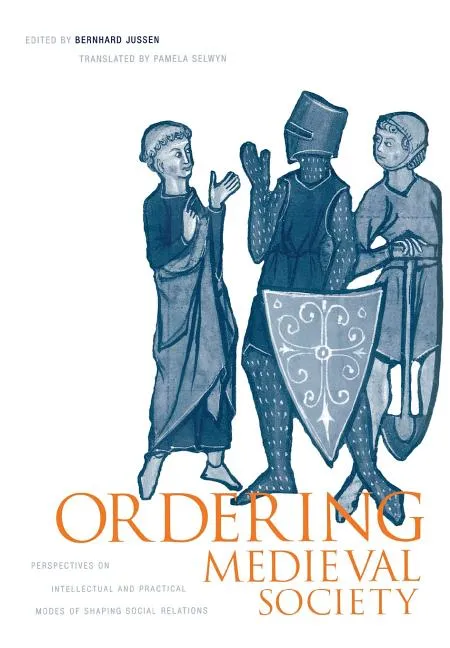
Ordering Medieval Society
Perspectives on Intellectual and Practical Modes of Shaping Social Relations
Report an issue
Tell us what's wrong and we'll take a look.
Thanks – we got it. We'll review and follow up if needed.
What intellectual and practical tools did medieval peoples employ in situations of disorder? How did they attempt to maintain cultural stability? Arguing against the common notion of a static medieval society organized along kinship and feudal lines, the contributors to Ordering Medieval Society--among them some of Germany's most influential medieval historians--reveal the diverse egalitarian and hierarchical forms of organization that medieval societies used to forge group structure.
In the book's first section, "Conceiving," the authors examine intellectual modes of ordering society. They study the different patterns of social classification in the Middle Ages, including the tripartite division between clergy, knights, and peasants. The medieval system of "counting piety" through quantifiable modes of penance provided another way to define social relations. The second part, "Transforming," focuses on times of disorder when social relations were reordered at once intellectually and practically. This section analyzes the transformation of political institutions in fifth-century Gaul in a shift from a Roman to a medieval ideology. Charting a much later institutional transformation, the book provocatively argues that the concept of "the nobility" is a fourteenth-century invention. The final section, "Stabilizing," considers mechanisms for the constitution of egalitarian groups and highly developed systems for conflict resolution in medieval group culture.
Contributors: Gerd Althoff, Arnold Angenendt, Thomas Braucks, Rolf Busch, Bernhard Jussen, Thomas Lentes, Hubertus Lutterbach, Joseph Morsel, Otto Gerhard Oexle.


Why Readwise Books?
Readwise Books is an ebook & audiobook platform that automatically logs how much you and your friends read, making it fun and easy to read more. Learn more →