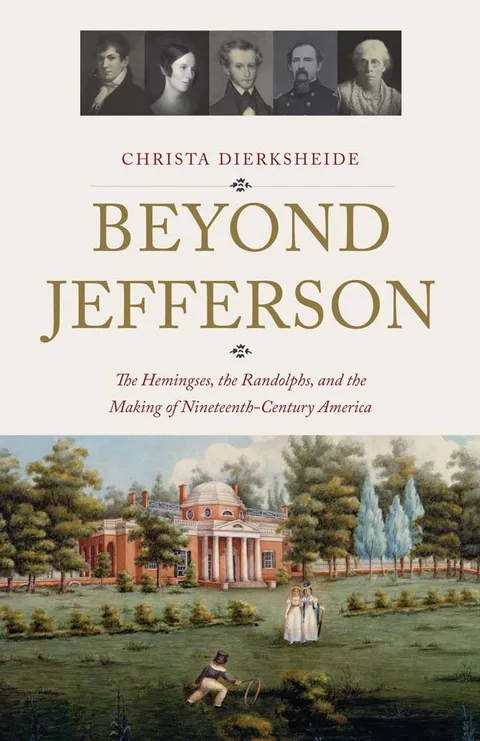
Beyond Jefferson
The Hemingses, the Randolphs, and the Making of Nineteenth-Century America
Report an issue
Tell us what's wrong and we'll take a look.
Thanks – we got it. We'll review and follow up if needed.
The Declaration of Independence identified two core principles--independence and equality--that defined the American Revolution and the nation forged in 1776. Jefferson believed that each new generation of Americans would have to look to the "experience of the present" rather than the "wisdom" of the past to interpret and apply these principles in new and progressive ways.
Historian Christa Dierksheide examines the lives and experiences of a rising generation of Jefferson's descendants, Black and white, illuminating how they redefined equality and independence in a world that was half a century removed from the American Revolution. The Hemingses and Randolphs moved beyond Jefferson and his eighteenth-century world, leveraging their own ideas and experiences in nineteenth-century Britain, China, Cuba, Mexico, and the American West to claim independence and equal rights in an imperial and slaveholding republic.
Christa Dierksheide
Christa Dierksheide is Brockman Foundation Jefferson Scholars Foundation Professor of History at the University of Virginia. She is the author of Beyond Jefferson: The Hemingses, the Randolphs, and the Making of Nineteenth-Century America and Amelioration and Empire: Progress and Slavery in the Plantation Americas, 1770-1840. Formerly the Historian at the Robert H. Smith Center for Jefferson Studies at Monticello, she has curated and contributed to numerous related exhibitions.
More by Christa Dierksheide


Why Readwise Books?
Readwise Books is an ebook & audiobook platform that automatically logs how much you and your friends read, making it fun and easy to read more. Learn more →