Report an issue
Tell us what's wrong and we'll take a look.
Thanks – we got it. We'll review and follow up if needed.
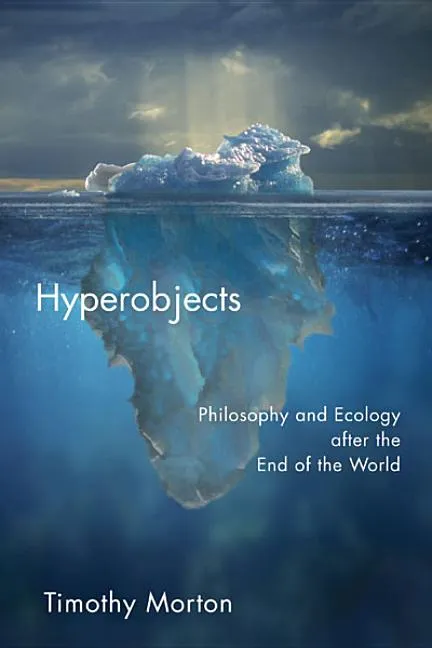
Having set global warming in irreversible motion, we are facing the possibility of ecological catastrophe. But the environmental emergency is also a crisis for our philosophical habits of thought, confronting us with a problem that seems to defy not only our control but also our understanding. Global warming is perhaps the most dramatic example of what Timothy Morton calls "hyperobjects"--entities of such vast temporal and spatial dimensions that they defeat traditional ideas about what a thing is in the first place. In this book, Morton explains what hyperobjects are and their impact on how we think, how we coexist with one another and with nonhumans, and how we experience our politics, ethics, and art.
Moving fluidly between philosophy, science, literature, visual and conceptual art, and popular culture, the book argues that hyperobjects show that the end of the world has already occurred in the sense that concepts such as world, nature, and even environment are no longer a meaningful horizon against which human events take place. Instead of inhabiting a world, we find ourselves inside a number of hyperobjects, such as climate, nuclear weapons, evolution, or relativity. Such objects put unbearable strains on our normal ways of reasoning.
Insisting that we have to reinvent how we think to even begin to comprehend the world we now live in, Hyperobjects takes the first steps, outlining a genuinely postmodern ecological approach to thought and action.
Timothy Morton
Timothy Morton is Rita Shea Guffey Chair in English at Rice University. They have collaborated with Bj�rk, Laurie Anderson, Jennifer Walshe, Hrafnhildur Arnadottir, Sabrina Scott, Adam McKay, Jeff Bridges, Justin Guariglia, Olafur Eliasson, and Pharrell Williams. Morton co-wrote and appears in Living in the Future's Past, a 2018 film about global warming with Jeff Bridges. They are the author of the libretto for the opera Time Time Time by Jennifer Walshe. Morton has written Being Ecological (Penguin, 2018), Humankind: Solidarity with Nonhuman People (Verso, 2017), Dark Ecology: For a Logic of Future Coexistence (Columbia, 2016), Nothing: Three Inquiries in Buddhism (Chicago, 2015), Hyperobjects: Philosophy and Ecology after the End of the World (Minnesota, 2013), Realist Magic: Objects, Ontology, Causality (Open Humanities, 2013), The Ecological Thought (Harvard, 2010), Ecology without Nature (Harvard, 2007), 8 other books and 250 essays on philosophy, ecology, literature, music, art, architecture, design and food. Morton's work has been translated into 10 languages. In 2014 they gave the Wellek Lectures in Theory.
More by Timothy Morton


Why Readwise Books?
Readwise Books is an ebook & audiobook platform that automatically logs how much you and your friends read, making it fun and easy to read more. Learn more →