Report an issue
Tell us what's wrong and we'll take a look.
Thanks – we got it. We'll review and follow up if needed.
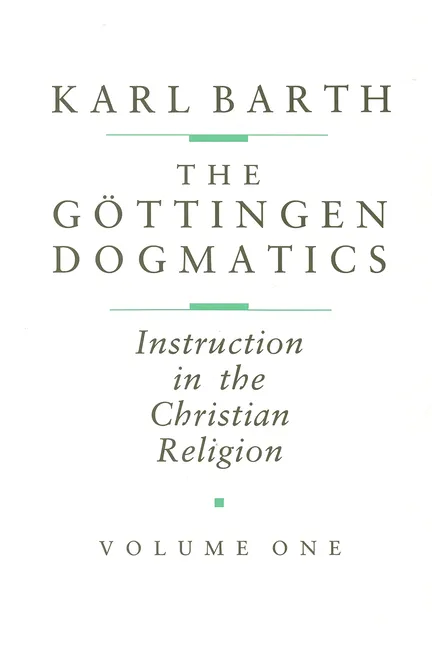
Representing the only larger dogmatics ever completed by Barth, the Göttingen Dogmaticsprefigures the unfinished Christian Dogmatics of Münster and the Church Dogmatics of Bonn and Basel. This translation by Geoffrey W. Bromiley, the premier translator of Barth, offers in two volumes the full text of Barth's Göttingen lectures according to the excellent three-volume Swiss edition in the Gesamtausgabe (Collected Words).
In this first volume Barth defines dogmatics as "scientific reflection on the Word of God" -- the Word that is (1) spoken by God in revelation, (2) recorded in holy scripture, and (3) proclaimed and heard in Christian preaching. After his lengthy prolegomena on the threefold form of the Word of God, Barth discusses in depth the doctrine of God. His treatment of the other major doctrinal loci in his preaching-oriented dogmatics -- anthropology, reconciliation, and redemption (eschatology) -- will appear in Volume Two.
Daniel L. Migliore, professor of systematic theology at Princeton Theological Seminary, has written a superb, substantive introduction that highlights the theological and historical significance of theGöttingen Dogmatics and compares this work with Barth's Church Dogmatics. Migliore points out, among other things, the intimate bond for Barth between dogmatics and preaching: in the Göttingen lectures we see a Barth "who tenaciously does theology -- indeed defines theology -- in relation to preaching and pastoral praxis."
Ministers, seminary students, scholars, and theologically minded general readers will all appreciate and benefit from the Göttingen Dogmatics. As Migliore writes, "These lectures not only provide exceedingly rich new material for understanding the development of Barth's thought but also offer a remarkably original, lively, and 'reader-friendly' summary of Barth's earthly theology. . . . The clarity, passion, originality, struggle, candor, and humor exhibited in these lectures will establish a permanent place for them in the history of twentieth-century theology."
Karl Barth
Karl Barth (1886-1968), the Swiss Reformed professor and pastor, was once described by Pope Pius XII as the most important theologian since Thomas Aquinas. As principal author of 'The Barmen Declaration', he was the intellectual leader of the German Confessing Church - the Protestant group that resisted the Third Reich. Barth's teaching career spanned nearly five decades. Removed from his post at Bonn by the Nazis in late 1934, Barth moved to Basel where he taught until 1962. Among Barth's many books, sermons, and essays are The Epistle to the Romans, Humanity of God, Evangelical Theology, and Church Dogmatics.
Evangelical Theology, American Lectures, 1962
Now available exclusively as a digitized audiobook from Apple iTunes.
More by Karl Barth


Why Readwise Books?
Readwise Books is an ebook & audiobook platform that automatically logs how much you and your friends read, making it fun and easy to read more. Learn more →