Report an issue
Tell us what's wrong and we'll take a look.
Thanks – we got it. We'll review and follow up if needed.
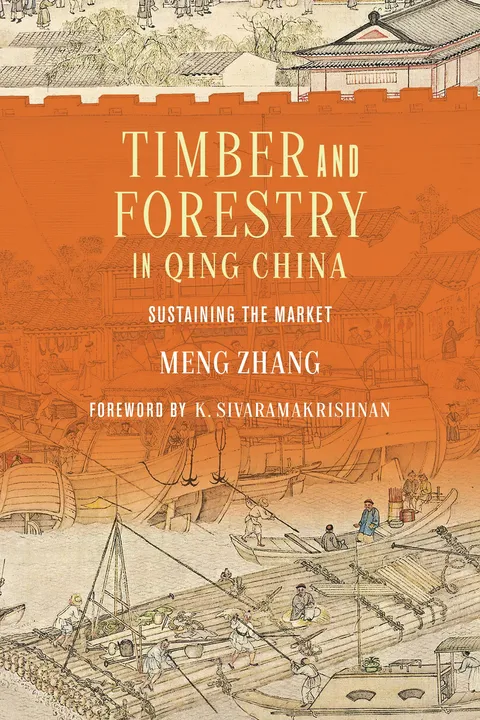
Winner of the 2022 Charles A. Weyerhaeuser Book Award for best book on forest and conservation history, sponsored by the Forest History Society
Honorable Mention for the 2022 ISCLH First Biennial Book Prize, sponsored by the International Society for Chinese Law and History
Traces the sourcing of logs that fueled early modern urbanization
In the Qing period (1644–1912), China's population tripled, and the flurry of new development generated unprecedented demand for timber. Standard environmental histories have often depicted this as an era of reckless deforestation, akin to the resource misuse that devastated European forests at the same time. This comprehensive new study shows that the reality was more complex: as old-growth forests were cut down, new economic arrangements emerged to develop renewable timber resources.
Historian Meng Zhang traces the trade routes that connected population centers of the Lower Yangzi Delta to timber supplies on China's southwestern frontier. She documents innovative property rights systems and economic incentives that convinced landowners to invest years in growing trees. Delving into rare archives to reconstruct business histories, she considers both the formal legal mechanisms and the informal interactions that helped balance economic profit with environmental management. Of driving concern were questions of sustainability: How to maintain a reliable source of timber across decades and centuries? And how to sustain a business network across a thousand miles? This carefully constructed study makes a major contribution to Chinese economic and environmental history and to world-historical discourses on resource management, early modern commercialization, and sustainable development.
Meng Zhang
Dr Meng Zhang is a Professor of environmental engineering at Zhejiang University, China. He earned his bachelor's and doctoral degrees in environmental engineering from Zhejiang University. He worked as a postdoc in Zhejiang University (2016-2018), and a Research Fellow at Nanyang Technological University of Singapore (2018-2021). His research interests focus on wastewater treatment, environmental biotechnology and microbiology, and nutrient removal and recovery from wastewater. Dr Zhang has published more than 100 journal papers in the mainstream environmental science and engineering journals (Google Scholar Citations about 3800; H-index 39, as of May 2024). As co-editor, he also publishes an IWA book. Currently, he is the editorial board member of Results in Engineering, China Water & Wastewater, and the member of IWA-YWP China.
More by Meng Zhang


Why Readwise Books?
Readwise Books is an ebook & audiobook platform that automatically logs how much you and your friends read, making it fun and easy to read more. Learn more →