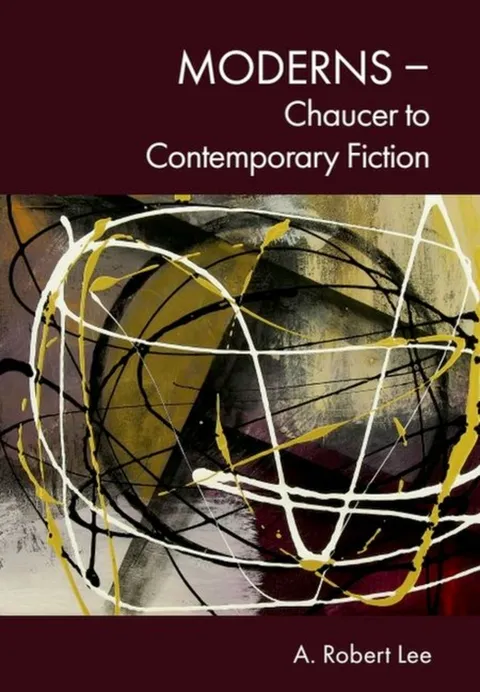
Moderns - Chaucer to Contemporary Fiction
Report an issue
Tell us what's wrong and we'll take a look.
Thanks – we got it. We'll review and follow up if needed.
In this compelling new book, A. Robert Lee tackles the questions: how, and why, does a literary work assume the mantle of 'modern'? He shows, with wit and verve, that writing as far back as Chaucer's The Canterbury Tales can be called 'modern'. That the term further applies to John Skelton's poetry and to Shakespeare's Hamlet and to the sexual and theological verse of John Donne. That 'modern' literary experimentation holds as you read Sterne's Tristram Shandy, the poetry of Byron, the gothic of Mary Wollstonecraft Shelley, the essays of Hazlitt, a novel like Conrad's The Secret Agent and the work of Samuel Butler, Lytton Strachey and Ford Madox Ford. That with writers such as Mina Loy, Dorothy Richardson and Jean Rhys you have a gallery of the feminist modern. These 'ultra' moderns segue into the postmodern turn of B.S. Johnson and Ann Quin and to boundary-pushing contemporary fiction, from Bernardine Evaristo to Alan Hollinghurst. However singular each writer, Lee argues persuasively for a distinctive collection of 'modern' voices.


Why Readwise Books?
Readwise Books is an ebook & audiobook platform that automatically logs how much you and your friends read, making it fun and easy to read more. Learn more →