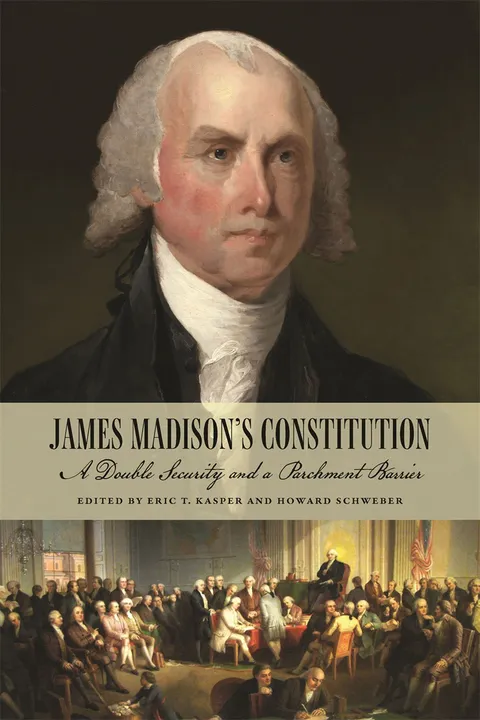
James Madison's Constitution
A Double Security and a Parchment Barrier
Report an issue
Tell us what's wrong and we'll take a look.
Thanks – we got it. We'll review and follow up if needed.
In James Madison's Constitution, Eric T. Kasper and Howard Schweber have assembled a roster of ten prominent contributors to excavate Madison’s thinking about key concepts and issues over questions of what the Constitution requires, permits, and prohibits. Madison’s key role at the Constitution’s drafting was instrumental in forging the document into what it is today.
In many areas, the modern Constitution still reflects Madison’s conception and design. In other areas, however, the Constitution as it emerged in a final text—and as it has been amended and interpreted to the present day—does not always conform to Madison’s vision. Nevertheless, examining Madison’s thinking across a range of constitutional issues has much to offer for understanding our nation’s primary governing document today. Indeed, there are great disagreements among jurists, policymakers, journalists, academics, and the general public about how to interpret the Constitution and what various clauses mean. Frequently, Madison is cited as a source on both sides of political, scholarly, and legal debates over the meaning of various constitutional provisions.
CONTRIBUTORS: Jeff Broadwater, Paul Finkelman, Zachary K. German, Alan R. Gibson, Jack N. Rakove, David J. Siemers, Quentin P. Taylor, George Thomas, Lynn Uzzell, and Michael P. Zuckert
Eric T Kasper
Eric T. Kasper is Professor of Political Science and Director of the Menard Center for Constitutional Studies at the University of Wisconsin-Eau Claire. He is the coauthor of The Supreme Court and the Philosopher: How John Stuart Mill Shaped US Free Speech Protections.


Why Readwise Books?
Readwise Books is an ebook & audiobook platform that automatically logs how much you and your friends read, making it fun and easy to read more. Learn more →