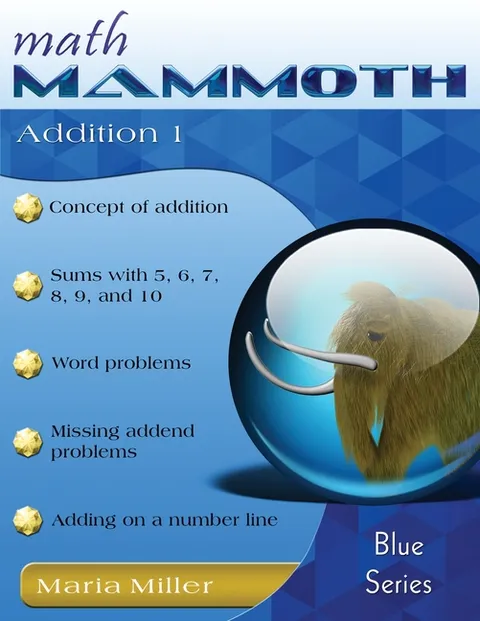
Math Mammoth Addition 1
Report an issue
Tell us what's wrong and we'll take a look.
Thanks – we got it. We'll review and follow up if needed.
Math Mammoth Addition 1 is a worktext (includes both teaching and exercises) dealing with the concept of addition and addition facts within 0-10 (in few occasions numbers between 10 and 20 are used). The book is most suitable for first grade.
The book starts out with very easy addition problems within 0-5 using pictures. If the student does not yet know the symbols + and = you can introduce them first orally. In other words use blocks or rocks and make addition problems where you use both kinds of wordings: "Three blocks and four blocks makes seven blocks. Three blocks PLUS four blocks EQUALS seven blocks." Play like that until the child can use the words PLUS and EQUALS in his/her own speech. This will make it easier for him/her to use the written symbols.
Soon the lessons start including "missing addend" problems. We first use pictures and gradually get to the abstract 1 + __ = 5 with symbols only. Keep in mind that children may confuse this problem with
1 + 5 = __. You can word these problems like this: "1 and how many more makes 5?" You can MODEL them by drawing: First draw 1 ball. Tell the child that we need to have a total of 5 balls. He is to draw more until there are five balls. In the missing addend problem however many balls the child has to draw is the number that goes on the empty line. So first there is one ball then we need to add (draw) some more to make 5. But how many more were drawn?
After that the book contains many lessons called Sums with... whose goal is to help the child memorize addition facts.
My approach to memorization is many-fold:
- Structured drill such as you see in the lessons Sums with 5 Sums with 6 and so on. This is not random drill because you will start it by showing the pattern or the structure in the facts. This will help the student to tie the addition facts in with a context and help him understand the facts more on a conceptual level instead of merely memorizing them at random. In sums with 5 the child learns the number combinations that add up to 5: 0 & 5 1 & 4 and 2 & 3. This understanding is the basis for the drills.
- Using addition facts in games in math problems everyday life or anywhere else. Games are especially useful because they help children like mathematics.
- Random drilling may also be used as a tool among others.
- Memory helps such as silly mnemonics or writing math facts on a poster and hanging it on the wall. These are not needful for all children.
However keep in mind that children will need LOTS of opportunities to add numbers to actually memorize the facts so the memorization may not totally occur as your child works through this book. These same addition facts are further studied and used in the Math Mammoth Subtraction 1 book and in all later math work since they are constantly used. At the latest your child should memorize addition facts during second grade.
Maria Miller
Maria Miller was born and grew up in Finland where she also received a master's degree in mathematics in 1997. She loves math and teaching, so becoming a math teacher was a natural career for her. Miller started writing math books in 2002, prompted by her experiences in tutoring homeschooled children. She felt the books they were using were inferior, especially when it came to conceptual understanding of mathematics, so she began to write books that focus on the concepts and the "why" of mathematics, though not forgetting the "how" and the needful practice. Over the years, her materials have become popular and appreciated, both among parents and teachers. In her free time, she likes walking, bicycling, swimming, reading, helping out with Inspire4.com, playing piano, and listening to music.
More by Maria Miller


Why Readwise Books?
Readwise Books is an ebook & audiobook platform that automatically logs how much you and your friends read, making it fun and easy to read more. Learn more →