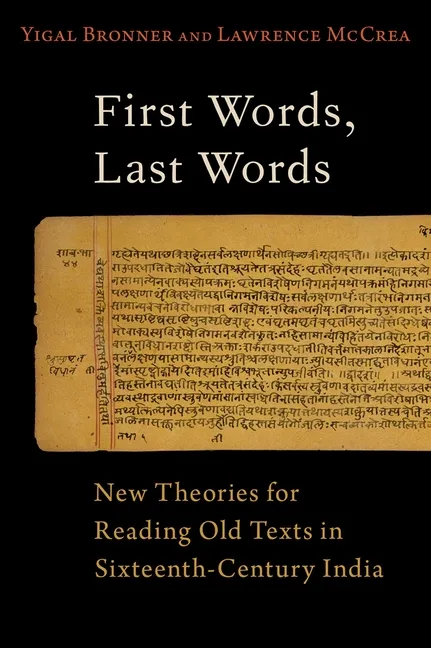
First Words, Last Words
New Theories for Reading Old Texts in Sixteenth-Century India
Report an issue
Tell us what's wrong and we'll take a look.
Thanks – we got it. We'll review and follow up if needed.
Bronner and McCrea examine the nature of theoretical innovation in scholastic traditions by focusing on a specific controversy regarding scriptural interpretation and the role of sequence-what comes first and what follows later-in determining our interpretation of a scriptural passage.
Vyāsatīrtha and his grand-pupil Vijayīndratīrtha, writers belonging to the camp of Dualist Vedānta, purported to uphold the radical view of their founding father, Madhva, who believed, against a long tradition of Mīmāṃsā interpreters, that the closing portion of a scriptural passage should govern the interpretation of its opening. By contrast, the Nondualist Appayya Dīkṣita ostensibly defended his tradition's preference for the opening. But, as this volume shows, the debaters gradually converged on a profoundly novel hermeneutic-cognitive theory in which sequence played little role, if any.
First Words, Last Words traces both the issue of sequence and the question of innovation through an in-depth study of this debate and through a comparative survey of similar problems in Judaism, Christianity, and Islam, revealing that the disputants in this controversy often pretended to uphold traditional views, when they were in fact radically innovative.













Why Readwise Books?
Readwise Books is an ebook & audiobook platform that automatically logs how much you and your friends read, making it fun and easy to read more. Learn more →