Report an issue
Tell us what's wrong and we'll take a look.
Thanks – we got it. We'll review and follow up if needed.
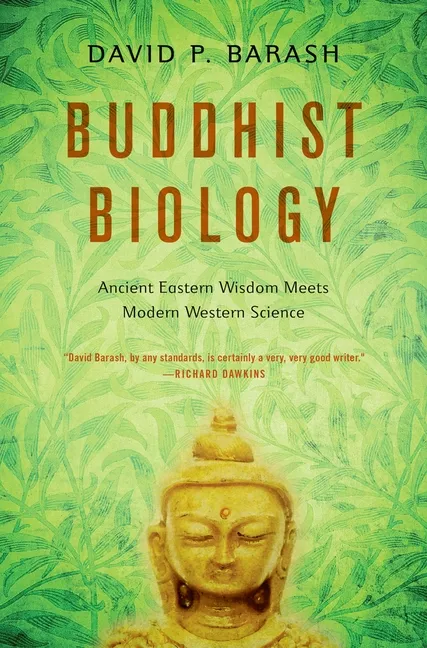
In this fascinating book, David Barash highlights the intriguing common ground between scientific and religious thought, illuminating the many parallels between biology and Buddhism, allowing readers to see both in a new way. Indeed, he shows that there are numerous places where Buddhist and biological perspectives coincide and reinforce each other. For instance, the cornerstone ecological concept -- the interconnectedness and interdependence of all natural things -- is remarkably similar to the fundamental insight of Buddhism. Indeed, a major Buddhist text, the Avatamsaka Sutra, which consists of ten insights into the "interpenetration" between beings and their environment, could well have been written by a trained ecologist, just as current insights in evolutionary biology, genetics and development might have been authored by the Buddha himself. Barash underscores other notable similarities, including a shared distrust of simple cause-and-effect analysis, an appreciation of the "rightness" of nature, along with an acknowledgment of the suffering that results when natural processes are tampered with. Buddhist Biology shows how the concept of "non-self," so confusing to many Westerners, is fully consistent with modern biology, as is the Buddhist perspective of "impermanence." Barash both demystifies and celebrates the biology of Buddhism and vice versa, showing in a concluding tour-de-force how modern Buddhism --shorn of its hocus-pocus and abracadabra -- not only justifies but actually mandates both socially and environmentally "engaged" thought and practice.
Buddhist Biology is a work of unique intellectual synthesis that sheds astonishing light on biology as well as on Buddhism, highlighting the remarkable ways these two perspectives come together, like powerful searchlights that offer complementary and stunning perspectives on the world and our place in it.
David P. Barash
David P. Barash is professor emeritus of psychology at the University of Washington and has received numerous grants and awards. A Fellow of the American Association for the Advancement of Science, he has authored more than 250 peer-reviewed technical articles, published op-eds in The New York Times and The Los Angeles Times, contributed to The Chronicle of Higher Education, The Harvard Business Review, The History News Network, Psychology Today, among other publications, and has written, co-authored, and edited more than forty books. He lives in Goleta, California with his wife, four cats, three dogs and a horse.
More by David P. Barash














Why Readwise Books?
Readwise Books is an ebook & audiobook platform that automatically logs how much you and your friends read, making it fun and easy to read more. Learn more →