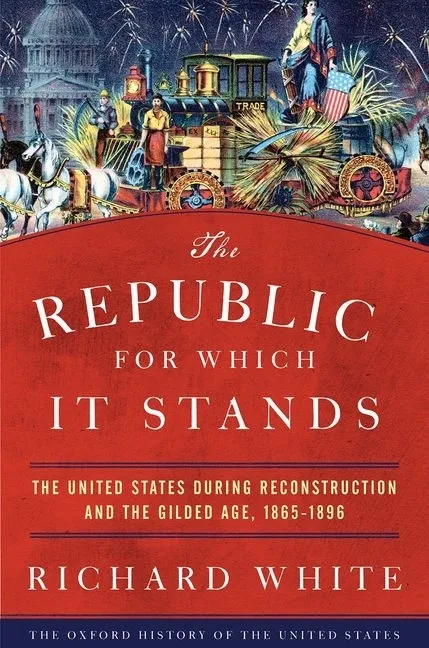
The Republic for Which It Stands
The United States During Reconstruction and the Gilded Age, 1865-1896
Report an issue
Tell us what's wrong and we'll take a look.
Thanks – we got it. We'll review and follow up if needed.
At the end of the Civil War the leaders and citizens of the victorious North envisioned the country's future as a free-labor republic, with a homogenous citizenry, both black and white. The South and West were to be reconstructed in the image of the North. Thirty years later Americans occupied an unimagined world. The unity that the Civil War supposedly secured had proved ephemeral. The country was larger, richer, and more extensive, but also more diverse. Life spans were shorter, and physical well-being had diminished, due to disease and hazardous working conditions. Independent producers had become wage earners. The country was Catholic and Jewish as well as Protestant, and increasingly urban and industrial. The "dangerous" classes of the very rich and poor expanded, and deep differences -- ethnic, racial, religious, economic, and political -- divided society. The corruption that gave the Gilded Age its name was pervasive.
These challenges also brought vigorous efforts to secure economic, moral, and cultural reforms. Real change -- technological, cultural, and political -- proliferated from below more than emerging from political leadership. Americans, mining their own traditions and borrowing ideas, produced creative possibilities for overcoming the crises that threatened their country.
In a work as dramatic and colorful as the era it covers, White narrates the conflicts and paradoxes of these decades of disorienting change and mounting unrest, out of which emerged a modern nation whose characteristics resonate with the present day.
Richard White
Richard White is the Margaret Byrne Professor Emeritus of American History at Stanford University. He is the author of many acclaimed books in American western and environmental history, including Railroaded: The Transcontinentals and the Making of Modern America, winner of the Los Angeles Times Book Prize, the Parkman Prize, and a finalist for the Pulitzer Prize.
More by Richard White














Why Readwise Books?
Readwise Books is an ebook & audiobook platform that automatically logs how much you and your friends read, making it fun and easy to read more. Learn more →