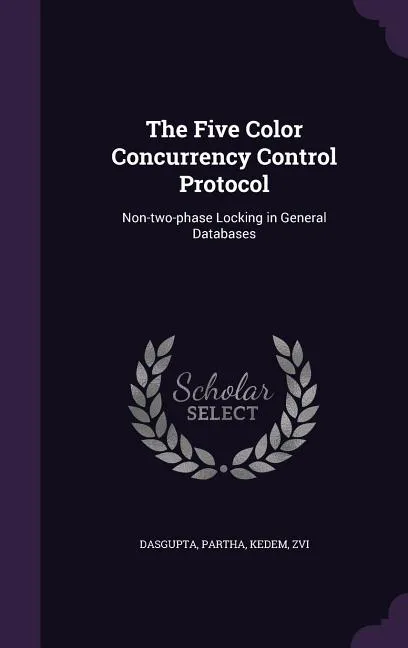
The Five Color Concurrency Control Protocol
Non-two-phase Locking in General Databases
Report an issue
Tell us what's wrong and we'll take a look.
Thanks – we got it. We'll review and follow up if needed.
This work has been selected by scholars as being culturally important, and is part of the knowledge base of civilization as we know it. This work was reproduced from the original artifact, and remains as true to the original work as possible. Therefore, you will see the original copyright references, library stamps (as most of these works have been housed in our most important libraries around the world), and other notations in the work.
This work is in the public domain in the United States of America, and possibly other nations. Within the United States, you may freely copy and distribute this work, as no entity (individual or corporate) has a copyright on the body of the work.
As a reproduction of a historical artifact, this work may contain missing or blurred pages, poor pictures, errant marks, etc. Scholars believe, and we concur, that this work is important enough to be preserved, reproduced, and made generally available to the public. We appreciate your support of the preservation process, and thank you for being an important part of keeping this knowledge alive and relevant.
Partha Dasgupta
Sir Partha Dasgupta is the Frank Ramsey Professor Emeritus of Economics at the University of Cambridge, and a fellow of St John’s College, Cambridge. Previously, he taught at the London School of Economics and Stanford University. His research has covered development economics, the economics of technological change, population, social capital and ecological economics. In 2021 he was awarded the Kew International Medal of the Royal Botanic Gardens Kew and in 2023 was appointed Knight Grand Cross of the Order of the British Empire for ""services to economics and the natural environment."" In February 2024 he won The Frontiers of Knowledge Award.
More by Partha Dasgupta


Why Readwise Books?
Readwise Books is an ebook & audiobook platform that automatically logs how much you and your friends read, making it fun and easy to read more. Learn more →