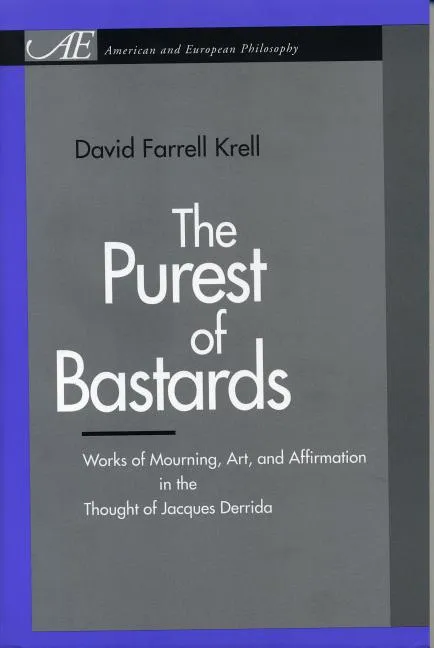
The Purest of Bastards
Works of Mourning, Art, and Affirmation in the Thought of Jacques Derrida
Report an issue
Tell us what's wrong and we'll take a look.
Thanks – we got it. We'll review and follow up if needed.
The "deconstruction" that is commonly seen to be the method of Derrida's philosophy has an inescapably negative connotation. To counter this view of Derrida's thought as basically destructive, David Farrell Krell invites readers to understand how it may instead be seen as fundamentally affirmative--just as Nietzsche's philosophy, so allegedly nihilistic, is at heart a call for tragic affirmation, in amor fati.
But, while affirmative, Derrida is also engaged in a thinking of mourning, which he views as the promise of memory--a fragile yet vital promise that binds past and future. The book explores what mourning means in Derrida's writing and how the labors of mourning and affirmation are mediated by works of art. Thus the book engages many different areas of Derrida's work, from the classic texts of deconstruction to the more recent meditations on art and mourning.
"This chance [affirmation without issue] can come to us only from you, do you hear me? Do you understand me? . . . And me, the purest of bastards, leaving bastards of all kinds just about everywhere." This passage from Derrida's La Carte postale nicely encapsulates what David Farrell Krell wants to convey about Derrida's thought--its astonishing mix of negativity and affirmation in his labors of mourning.
David Farrell Krell
David Farrell Krell is Emeritus Professor of Philosophy at DePaul University, Brauer Distinguished Visiting Professor of German Studies at Brown University, and Adjunct Professor of Philosophy at the Albert-Ludwig University of Freiburg. He is the author of many books, including Struck by Apollo: Hölderlin's Journeys to Bordeaux and Back and Beyond and A Black Forest Walden: Conversations with Henry David Thoreau and Marlonbrando, both by SUNY Press.
More by David Farrell Krell




Why Readwise Books?
Readwise Books is an ebook & audiobook platform that automatically logs how much you and your friends read, making it fun and easy to read more. Learn more →