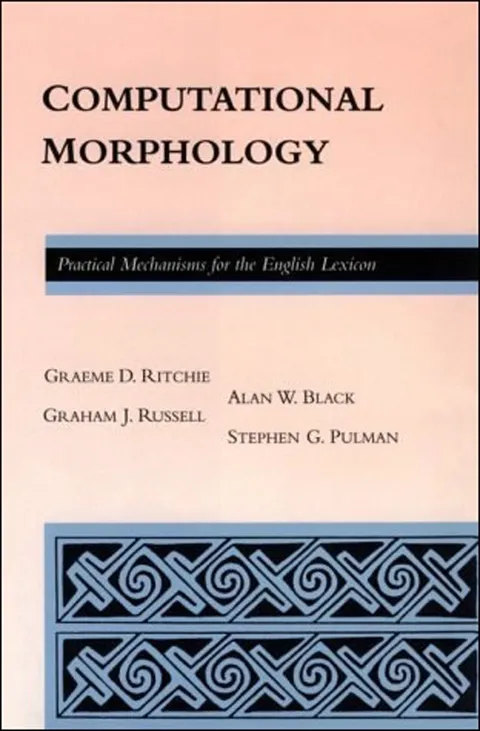
Computational Morphology
Practical Mechanisms for the English Lexicon
Report an issue
Tell us what's wrong and we'll take a look.
Thanks – we got it. We'll review and follow up if needed.
Previous work on morphology has largely tended either to avoid precise computational details or to ignore linguistic generality. Computational Morphology is the first book to present an integrated set of techniques for the rigorous description of morphological phenomena in English and similar languages. By taking account of all facets of morphological analysis, it provides a linguistically general and computationally practical dictionary system for use within an English parsing program. The authors cover morphographemics (variations in spelling as words are built from their component morphemes), morphotactics (the ways that different classes of morphemes can combine, and the types of words that result), and lexical redundancy (patterns of similarity and regularity among the lexical entries for words). They propose a precise rule-notation for each of these areas of linguistic description and present the algorithms for using these rules computationally to manipulate dictionary information. These mechanisms have been implemented in practical and publicly available software, which is described in detail, and appendixes contain a large number of computer-tested sets of rules and lexical entries for English.









Stephen Guy Pulman
Stephen G. Pulman is a Lecturer in the University of Cambridge Computer Laboratory and Director of SRI International's Cambridge Computer Science Research Centre.


Why Readwise Books?
Readwise Books is an ebook & audiobook platform that automatically logs how much you and your friends read, making it fun and easy to read more. Learn more →