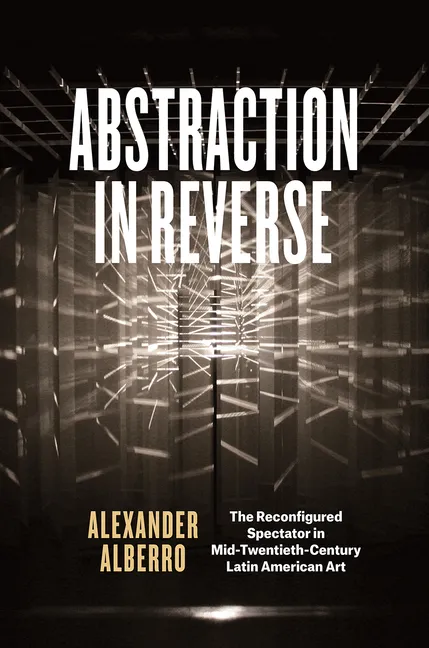
Abstraction in Reverse
The Reconfigured Spectator in Mid-Twentieth-Century Latin American Art
Report an issue
Tell us what's wrong and we'll take a look.
Thanks – we got it. We'll review and follow up if needed.
Alexander Alberro demonstrates that artists such as Tomás Maldonado, Jesús Soto, Julio Le Parc, and Lygia Clark, in breaking with the core tenets of the form of abstract art known as Concrete art, redefined the role of both the artist and the spectator. Instead of manufacturing autonomous art, these artists produced artworks that required the presence of the spectator to be complete. Alberro also shows the various ways these artists strategically demoted regionalism in favor of a new modernist voice that transcended the traditions of the nation-state and contributed to a nascent globalization of the art world.
Alexander Alberro
Alexander Alberro, Virginia Bloedel Wright Professor of Modern and Contemporary Art at Barnard College and Columbia University, is the author of Conceptual Art and the Politics of Publicity (Cambridge, MA: MIT Press, 2003). His essays have appeared in a wide array of journals and exhibition catalogues. He has also edited and co-edited a number of volumes, most recently Institutional Critique: An Anthology of Artists' Writings (Cambridge, MA: MIT Press, 2009).
More by Alexander Alberro



Why Readwise Books?
Readwise Books is an ebook & audiobook platform that automatically logs how much you and your friends read, making it fun and easy to read more. Learn more →