Report an issue
Tell us what's wrong and we'll take a look.
Thanks – we got it. We'll review and follow up if needed.
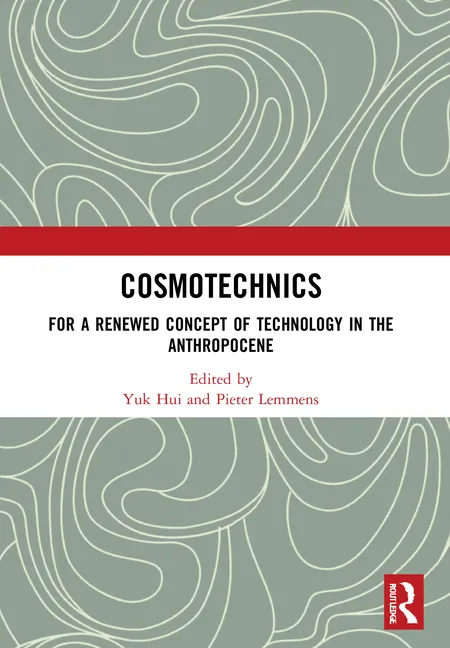
This volume is initial reflections on the meaning and the implications of Yuk Hui's notion of cosmotechnics, which opens up an anti-universalist and pluralist perspective on technology beyond the West.
Martin Heidegger's famous analysis of the essence of technology as enframing and as rooted in ancient Greek techne has had a crucial influence on the understanding and critique of technological society and culture in the twentieth century. However, it is still unclear to what extent his analysis can also be applied to the development of technology outside of 'the West', e.g. in China, Africa, and Latin America, particularly against the backdrop of receding Western domination and impending global ecological disaster. Acknowledging the planetary expansion of Western technology already observed by Heidegger, yet also recognizing the existence of non-Western origins of technical relationships to the cosmos, Yuk Hui's notion of cosmotechnics calls for a rethinking - in dialogue with decolonial studies and the so-called ontological turn in contemporary anthropology - of the question concerning technology which challenges the universality still present in Heidegger (as well as in Simondon and Stiegler) and proposes a radical technological or rather cosmotechnical pluralism or technodiversity. The contributors to this volume critically engage with this proposal and examine the possible implications of Hui's cosmotechnical turn in thinking about technology as it becomes a planetary force in our current age of the Anthropocene.
The chapters in this book were originally published as a special issue of Angelaki.
Yuk Hui
Yuk Hui is Full Professor of Philosophy at Erasmus University Rotterdam, the Netherlands, where he holds the Chair of Human Conditions. Hui studied computer engineering at the University of Hong Kong and philosophy at Goldsmiths College in London where he wrote his doctoral thesis under the French philosopher Bernard Stiegler (1952-2020). He obtained his Habilitation (venia legendi in philosophy of technology) from the Leuphana University Lüneburg. Hui is a juror of the Berggruen Prize for Philosophy and Culture since 2020, and convenor of the Research Network for Philosophy and Technology since 2014.
Pieter Lemmens
Pieter Lemmens teaches philosophy and ethics at the Institute for Science in Society(ISiS), at the Radboud University of Nijmegen, the Netherlands. He has published on themes in the philosophy of technology, philosophical anthropology and (post)phenomenology, and on the work of Martin Heidegger, Peter Sloterdijk, Bernard Stiegler, Mehdi Belhaj Kacem and post-autonomist Marxism. Recent book publications are Cosmotechnics. For a Renewed Concept of Technology in the Anthropocene (2021, co-edited with Y. Hui) and The Technical Condition. The Entanglement of Technology, Culture, and Society (2022, co-edited with T. Swierstra, T. Sharon and P. Vermaas).Current interests are the planetarization of technology and the technosphere and therenewal of philosophy of technology in the age of the Anthropocene.


Why Readwise Books?
Readwise Books is an ebook & audiobook platform that automatically logs how much you and your friends read, making it fun and easy to read more. Learn more →