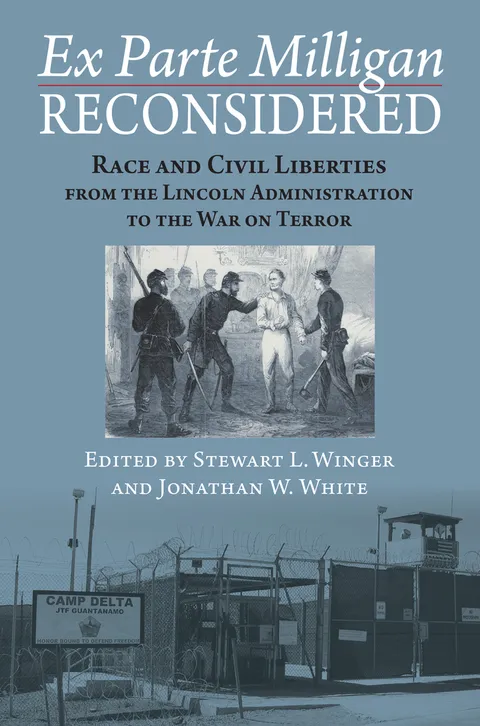
Ex Parte Milligan Reconsidered
Race and Civil Liberties from the Lincoln Administration to the War on Terror
Report an issue
Tell us what's wrong and we'll take a look.
Thanks – we got it. We'll review and follow up if needed.
After the Civil War, critics of Reconstruction pointed to Milligan as an example of the Republican Party's abuse of federal power; even historians sympathetic to Lincoln have found it necessary to apologize for his administration's record on civil liberties during the Civil War. However, the authors of this volume argue that this distorts the nineteenth-century understanding of the Bill of Rights, neglects international law entirely, and, equally striking, ignores the experience of African Americans. In reviving Milligan, the Supreme Court has implicitly cast Reconstruction as a "war on terror" in which terrorist insurgencies threatened and eventually halted the assertion of black freedom by the Republican Party, the Union Army, and African Americans themselves. Returning African Americans to the center of the story, and recognizing that Lincoln and Republicans were often forced to restrict white civil liberties in order to establish black civil rights and liberties, Ex parte Milligan Reconsidered suggests an entirely different account of wartime civil liberties, one with profound implications for US racial history and constitutional law in today's war on terror.
Stewart L Winger
Stewart L. Winger is associate professor of history at Illinois State University. Jonathan W. White is associate professor of American studies at Christopher Newport University.
Jonathan W. White
Jonathan W. White is an assistant professor of American Studies at Christopher Newport University, in Newport News, Virginia. He is the author of Abraham Lincoln and Treason in the Civil War: The Trials of John Merryman (Louisiana State University Press, 2011), and has another book, titled To Aid Their Rebel Friends: Politics and Treason in the Civil War North, under contract with LSU Press. White has published A Philadelphia Perspective:The Civil War Diary of Sidney George Fisher (Fordham University Press, 2007) and articles in Civil War History, American Nineteenth Century History, Ohio Valley History, and the Pennsylvania Magazine of History and Biography.


Why Readwise Books?
Readwise Books is an ebook & audiobook platform that automatically logs how much you and your friends read, making it fun and easy to read more. Learn more →