Report an issue
Tell us what's wrong and we'll take a look.
Thanks – we got it. We'll review and follow up if needed.
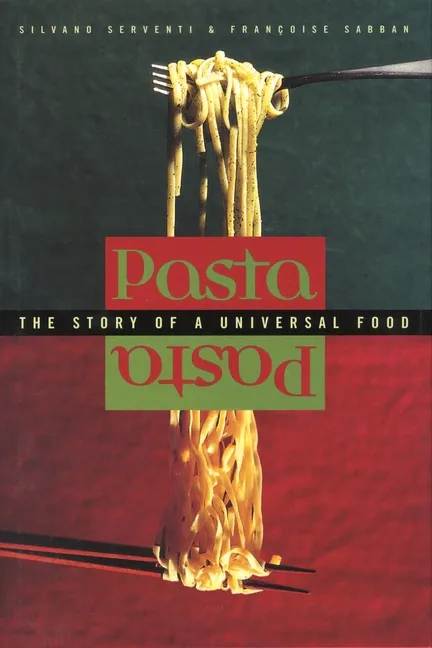
Ranging from the imperial palaces of ancient China and the bakeries of fourteenth-century Genoa and Naples all the way to the restaurant kitchens of today, Pasta tells a story that will forever change the way you look at your next plate of vermicelli. Pasta has become a ubiquitous food, present in regional diets around the world and available in a host of shapes, sizes, textures, and tastes. Yet, although it has become a mass-produced commodity, it remains uniquely adaptable to innumerable recipes and individual creativity. Pasta: The Story of a Universal Food shows that this enormously popular food has resulted from of a lengthy process of cultural construction and widely diverse knowledge, skills, and techniques.
Many myths are intertwined with the history of pasta, particularly the idea that Marco Polo brought pasta back from China and introduced it to Europe. That story, concocted in the early twentieth century by the trade magazine Macaroni Journal, is just one of many fictions umasked here. The true homelands of pasta have been China and Italy. Each gave rise to different but complementary culinary traditions that have spread throughout the world. From China has come pasta made with soft wheat flour, often served in broth with fresh vegetables, finely sliced meat, or chunks of fish or shellfish. Pastasciutta, the Italian style of pasta, is generally made with durum wheat semolina and presented in thick, tomato-based sauces. The history of these traditions, told here in fascinating detail, is interwoven with the legacies of expanding and contracting empires, the growth of mercantilist guilds and mass industrialization, and the rise of food as an art form.
Whether you are interested in the origins of lasagna, the strange genesis of the Chinese pasta bing or the mystique of the most magnificent pasta of all, the timballo, this is the book for you. So dig in!
Antony Shugaar
Translated by
Antony Shugaar is a writer and translator. Aside from Giorgio Faletti’s A Pimp’s Notes, his recent translations include books by Simonetta Agnello Hornby, Silvia Avallone, Nanni Balestrini (with an NEA translation fellowship), Fabio Bartolomei, Massimo Carlotto, Giancarlo De Cataldo, Diego De Silva, Marco Mancassola, Gianni Rodari, and Paolo Sorrentino. He is the author of Coast to Coast and I Lie for a Living and the coauthor, with the late Gianni Guadalupi, of Discovering America and Latitude Zero. He has published with the Washington Post, the Boston Globe, and online with the New York Times, among other publications. He is currently at work on a book about translation for the University of Virginia Press.


Why Readwise Books?
Readwise Books is an ebook & audiobook platform that automatically logs how much you and your friends read, making it fun and easy to read more. Learn more →