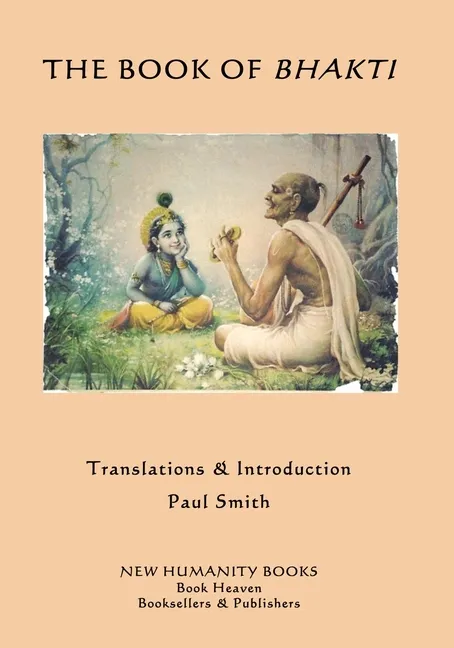
The Book of Bhakti
Report an issue
Tell us what's wrong and we'll take a look.
Thanks – we got it. We'll review and follow up if needed.
THE BOOK OF BHAKTI Translations & Introduction Paul Smith Bhakti is the love felt by the worshipper towards the personal God. While bhakti as designating a religious path is already a central concept in the Bhagavad Gita, it rises to importance in the medieval history of Hinduism, where the Bhakti Movement saw a rapid growth of bhakti beginning in Southern India with the Vaisnava Alvars (6th-9th century) and Saiva Nayanars (5th-10th century), who spread bhakti poetry and devotion throughout India by the 12th-18th century. It reached North India in the Delhi Sultanate. After their encounter with the expanding religion of Islam and especially Sufism, bhakti proponents, who were traditionally called 'saints, ' encouraged individuals to seek personal union with the divine. Its influence also spread to other religions. Here is an inspired complete translation of the most importan Bhakti texts the Bhagavad Gita by Vyasa and the Gita Govinda by Jayadeva. THE POETS: Appar, Andal, Jayadeva, Janabai, Namdev, Dnaneshwar, Lalla Ded, Vidyapati, Chandidas, Kabir, Nanak, Surdas, Mira Bai, Tulsidas, Eknath, Dadu, Rasakhan, Tukaram, Ramdas, Bahina Bai. Introduction on Bhakti & the Bhakti Poets of India & The Main Forms in the Bhakti Poetry of India. Selected Bibliography. The correct rhyme-structure and meaning is here in all of these beautiful, powerful, spiritual poems. Large Format Paperback 7" x 10 " Pages 336COMMENTS ON PAUL SMITH'S TRANSLATION OF HAFIZ'S 'DIVAN'."It is not a joke... the English version of ALL the ghazals of Hafiz is a great feat and of paramount importance. I am astonished. " Dr. Mir Mohammad Taghavi (Dr. of Literature) Tehran."Superb translations. 99% Hafiz 1% Paul Smith." Ali Akbar Shapurzman, translator from English into Persian, knower of Hafiz's Divan off by heart."Smith has probably put together the greatest collection of literary facts and history concerning Hafiz." Daniel Ladinsky (Penguin Books author). Paul Smith is a poet, author and translator of over 130 books of Sufi poets of the Persian, Arabic, Urdu, Turkish, Pashtu and other languages... including Hafiz, Sadi, Nizami, Rumi, 'Attar, Sana'i, Jahan Khatun, Obeyd Zakani, Mu'in, Amir Khusrau, Nesimi, Kabir, Anvari, Ansari, Jami, Omar Khayyam, Rudaki, Yunus Emre, Mahsati, Lalla Ded, Bulleh Shah, Shah Latif, Makhfi and many others, as well as his own poetry, fiction, plays, biographies, children's books and a dozen screenplays. amazon.com/author/smithpa Published by New Humanity Books
Paul Smith
Paul Smith is Professor of Cultural Studies and Global Affairs at George Mason University. Most of his working life has been spent in the US, including posts at Miami University OH, and Carnegie Mellon before his appointment at George Mason University in 1996. Between 1999 and 2002 he was chaired Professor and department head of Media and Cultural Studies at the University of Sussex. At George Mason he has been director of the Center for the Study of the Americas and currently teaches mostly in the Cultural Studies PhD program, but also for Global Affairs. He was elected President of the national Cultural Studies Association (2016-18). He is the author of Pound Revised, Discerning the Subject, Clint Eastwood: A Cultural Production, Millennial Dreams: Culture and Capital in the North, and Primitive America: The Ideology of Capitalist Democracy. He has edited Men in Feminism (with Alice Jardine), Madonnarama (with Lisa Frank), and Boys, and has published a book of translations from Jean Louis Schefer, The Enigmatic Body. His essays and articles have appeared in scores of journals and collections in the US and overseas. His most recent edited volume is The Renewal of Cultural Studies and he is currently completing a book on Covid vaccines.
More by Paul Smith











Why Readwise Books?
Readwise Books is an ebook & audiobook platform that automatically logs how much you and your friends read, making it fun and easy to read more. Learn more →