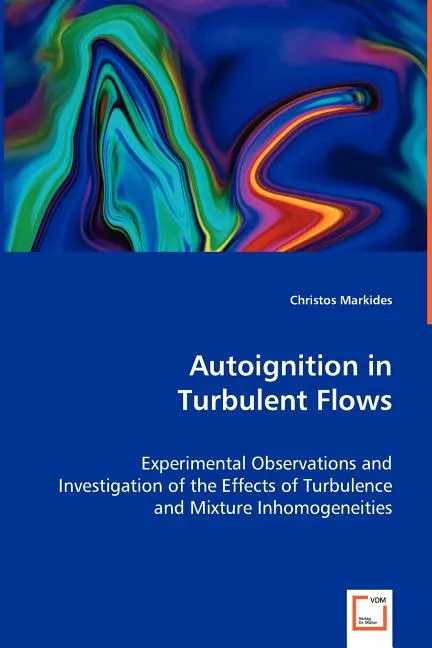
Autoignition in Turbulent Flows
Report an issue
Tell us what's wrong and we'll take a look.
Thanks – we got it. We'll review and follow up if needed.
In this work gaseous fuels were released continuously and concentrically into confined annular co-flows of turbulent hot air. Following injection the fuel and air mixed and at some length downstream of the nozzle the reactive mixture autoignited. Original phenomena are reported of autoignition spots, unsteady flame propagation and extinction or flashback. The frequency of the spots was measured, as were their acoustic and chemiluminescence characteristics. Optical measurements of the autoignition locations were made and used to estimate mean delay times from injection. As would be expected by considerations of simple chemical kinetics and the mean concentration field, higher air temperatures and lower fuel velocities resulted in autoignition closer to the injector. However, as the air velocity and hence also turbulent fluctuations were increased, autoignition shifted downstream and was delayed, while its frequency and sound intensity decreased. Such and other situations are presented that cannot be explained purely in terms of chemical arguments, i.e. homogeneous delay times, highlighting the significance of the mixing field through the mixture fraction and scalar dissipation rate.
Christos Markides
Professor Christos Markides is Professor in Clean Energy Technologies and Head of the Clean Energy Process (CEP) Laboratory numbering approx. 40 staff and students. He also leads the Energy Research Theme at the Department of Chemical Engineering, and the cross-faculty Energy Efficiency Network at Imperial College London. His current research interests focus primarily on the application of fundamental principles of thermodynamics, fluid mechanics, and heat and mass transfer to innovative renewable energy technologies, and high-performance components, devices and systems for energy (heat, power, cooling) recovery, conversion, integration and storage, with an emphasis on the efficient and cost-effective utilisation of low-temperature (solar or waste) heat. He has written more than 300 scientific articles in these areas, including sole-author and review articles, that have been published in journals or presented at international conferences.


Why Readwise Books?
Readwise Books is an ebook & audiobook platform that automatically logs how much you and your friends read, making it fun and easy to read more. Learn more →