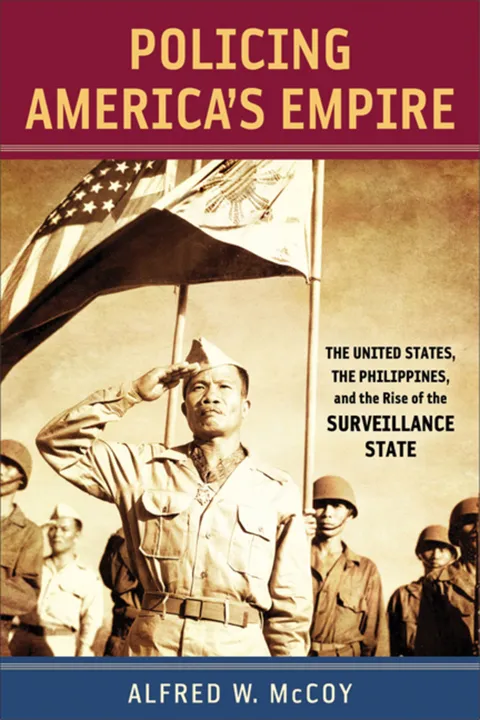
Policing Americaas Empire
The United States, the Philippines, and the Rise of the Surveillance State
Report an issue
Tell us what's wrong and we'll take a look.
Thanks – we got it. We'll review and follow up if needed.
But security techniques bred in the tropical hothouse of colonial rule were not contained, McCoy shows, at this remote periphery of American power. Migrating homeward through both personnel and policies, these innovations helped shape a new federal security apparatus during World War I. Once established under the pressures of wartime mobilization, this distinctively American system of public-private surveillance persisted in various forms for the next fifty years, as an omnipresent, sub rosa matrix that honeycombed U.S. society with active informers, secretive civilian organizations, and government counterintelligence agencies. In each succeeding global crisis, this covert nexus expanded its domestic operations, producing new contraventions of civil liberties--from the harassment of labor activists and ethnic communities during World War I, to the mass incarceration of Japanese Americans during World War II, all the way to the secret blacklisting of suspected communists during the Cold War.
"With a breathtaking sweep of archival research, McCoy shows how repressive techniques developed in the colonial Philippines migrated back to the United States for use against people of color, aliens, and really any heterodox challenge to American power. This book proves Mark Twain's adage that you cannot have an empire abroad and a republic at home."--Bruce Cumings, University of Chicago
"This book lays the Philippine body politic on the examination table to reveal the disease that lies within--crime, clandestine policing, and political scandal. But McCoy also draws the line from Manila to Baghdad, arguing that the seeds of controversial counterinsurgency tactics used in Iraq were sown in the anti-guerrilla operations in the Philippines. His arguments are forceful."--Sheila S. Coronel, Columbia University "Conclusively, McCoy's Policing America's Empire is an impressive historical piece of research that appeals not only to Southeast Asianists but also to those interested in examining the historical embedding and institutional ontogenesis of post-colonial states' police power apparatuses and their apparently inherent propensity to implement illiberal practices of surveillance and repression."--Salvador Santino F. Regilme, Jr., Journal of Current Southeast Asian Affairs "McCoy's remarkable book . . . does justice both to its author's deep knowledge of Philippine history as well as to his rare expertise in unmasking the seamy undersides of state power."--POLAR: Political and Legal Anthropology Review Winner, George McT. Kahin Prize, Southeast Asian Council of the Association for Asian Studies


Why Readwise Books?
Readwise Books is an ebook & audiobook platform that automatically logs how much you and your friends read, making it fun and easy to read more. Learn more →