Report an issue
Tell us what's wrong and we'll take a look.
Thanks – we got it. We'll review and follow up if needed.
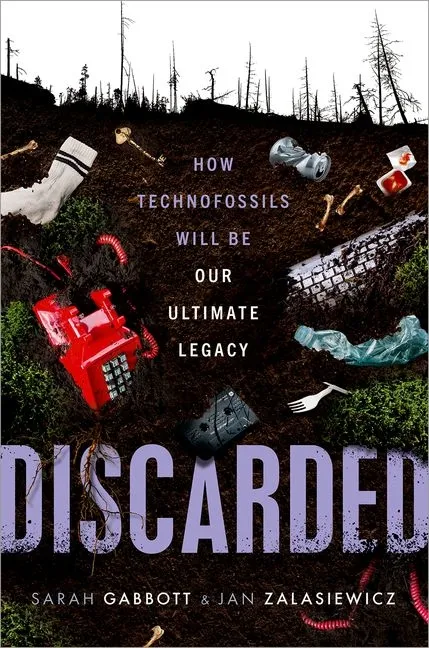
What kind of fossils will we leave, as relics into the far future? A blizzard of new objects has suddenly appeared on Earth: plastic bottles, ballpoint pens, concrete flyways, outsize chicken bones, aluminium cans, teabags, mobile phones, T-shirts. They're produced for our comfort and pleasure--then quickly discarded. The number of our constructions has exploded, to outweigh the whole living world. This new-made treasure chest underpins our lives. But it is also giving a completely new style of fossilization to our planet, as hyper-diverse and hyper-rapidly-evolving technofossils spin out of our industrialized economy. Designed to resist sun, wind, rain, corrosion and decay, and buried in soils, seafloor muds and the gigantic middens of our landfill sites, many will remain, petrified, as future geology.
What will these technofossils look like, in future rock? How long will they last and how will they change, as they lie underground for decades, then millennia, then millions of years? Discarded describes how they transform as they are attacked by bacteria, baked by the Earth's inner heat, squashed by overlying rock, permeated by subterranean fluids, crumpled by mountain-building movements--and what will be left of them. These new fossils also have meaning for our lives today. For we live on a world increasingly buried under our growing waste. As our discarded artefacts begin to change into fossils, they may be swallowed by birds, entangle fish, alter microbial communities and release toxins. Even deeply buried in rock, technofossils may break down into new-formed oil and gas, change the composition of groundwater, and attract new mineral growths. They will have a lasting impact.
It is a new planetary phenomenon, now unfolding around us. Scientists are only just beginning to grasp its scale, and get to grips with how it functions. This book describes, for the general reader, the kind of science that is emerging to show the far-future human footprint on Earth. It offers a different perspective upon fossils and fossilization, one that expands the idea of what people think of as fossils, and what they can tell us.
Jan Zalasiewicz
Jan Zalasiewicz is geologist, paleontologist, and stratigrapher. He is Emeritus Professor of Palaeobiology at the University of Leicester, UK and a member of the Anthropocene Working Group. He focuses on geology and Earth history, in particular on fossil ecosystems and environments that span over half a billion years of geological time. He has taught students how to interpret rocks and rock structures for more than 20 years in the field and lecture halls, as well as leading field trips for geological groups.
More by Jan Zalasiewicz



Why Readwise Books?
Readwise Books is an ebook & audiobook platform that automatically logs how much you and your friends read, making it fun and easy to read more. Learn more →