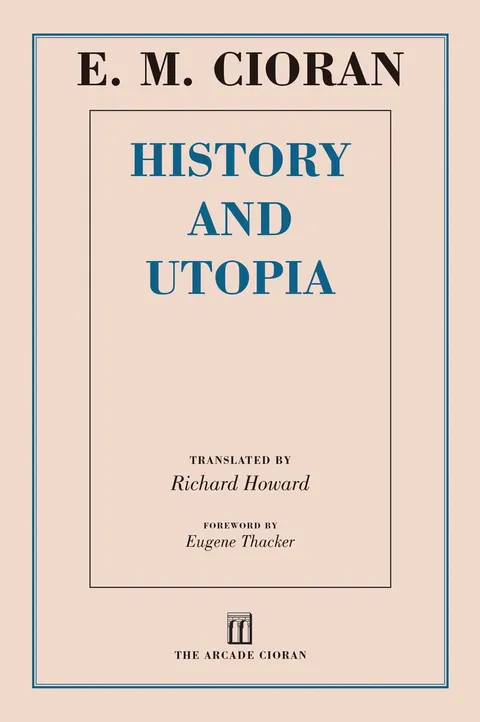
History and Utopia
Report an issue
Tell us what's wrong and we'll take a look.
Thanks – we got it. We'll review and follow up if needed.
“Only a monster can allow himself the luxury of seeing things as they are,” writes E. M. Cioran, the Romanian-born philosopher who has rightly been compared to Samuel Beckett.
In History and Utopia, Cioran the monster writes of politics in its broadest sense, of history, and of the utopian dream. His views are, to say the least, provocative. In one essay he casts a scathing look at democracy, that “festival of mediocrity”; in another he turns his uncompromising gaze on Russia, its history, its evolution, and what he calls “the virtues of liberty.” In the dark shadow of Stalin and Hitler, he writes of tyrants and tyranny with rare lucidity and convincing logic. In “Odyssey of Rancor,” he examines the deep-rooted dream in all of us to “hate our neighbors,” to take immediate and irremediable revenge. And, in the final essay, he analyzes the notion of the “golden age,” the biblical Eden, the utopia of so many poets and thinkers.
Richard Howard
Translated by
Richard Howard (1929-2022) hold a distinguished place in contemporary American literature for his work as a poet, translator, critic, and educator.


Why Readwise Books?
Readwise Books is an ebook & audiobook platform that automatically logs how much you and your friends read, making it fun and easy to read more. Learn more →