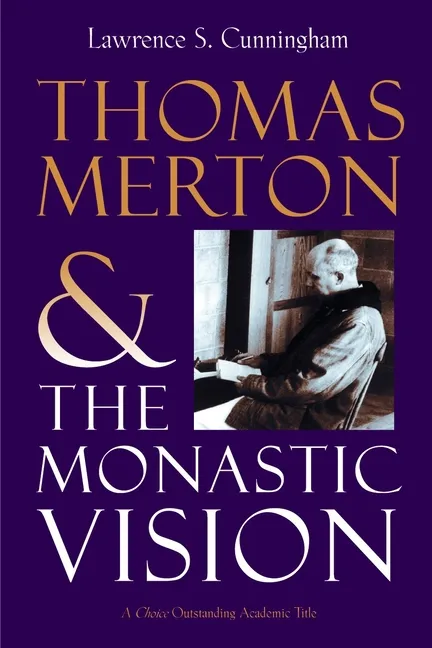
Thomas Merton and the Monastic Vision
Report an issue
Tell us what's wrong and we'll take a look.
Thanks – we got it. We'll review and follow up if needed.
Cunningham shows that Merton's prolific writings and his continuing influence can only be understood against the background of his contemplative experience as a Trappist monk. "If one does not understand Merton as a monk," writes Cunningham, "one does not understand Merton at all."
Following the trajectory of Merton's life, starting from his entrance into the Abbey of Gethsemani, Kentucky, in 1941, Cunningham highlights the development of Merton's monastic life against the cultural background of the American experience and the vast upheavals in the Roman Catholic Church. This unique approach clearly reveals the paradox of Merton's life. Here was a person deeply involved in the cultural struggles of his day despite having made a conscious decision to draw away from the world in silence and solitude. With both pen and voice, Merton construed to face the most seething issues of the century, including the antiwar and civil-rights movements. Equally intriguing was Merton's dialogue with Zen Buddhism, a figurative and literal journey to the East that ended with his death in Bangkok in 1968.
Adding to the interest of this balanced and reliable biography is a foreword by Father Timothy Kelly, the current abbot of the Abbey of Gethsemani, who was himself a novice under Merton.
Lawrence S Cunningham
Lawrence S. Cunningham is the John A. O'Brien Professor of Theology (Emeritus) at the University of Notre Dame. He is the award-winning author or editor of numerous books and articles related to the history of Christianity, the saints, theology, and Catholicism. Cunningham is the recipient of several honorary degrees, a number of teaching awards, and is a 2013 Spirit of Holy Cross Award winner.
More by Lawrence S Cunningham



Why Readwise Books?
Readwise Books is an ebook & audiobook platform that automatically logs how much you and your friends read, making it fun and easy to read more. Learn more →