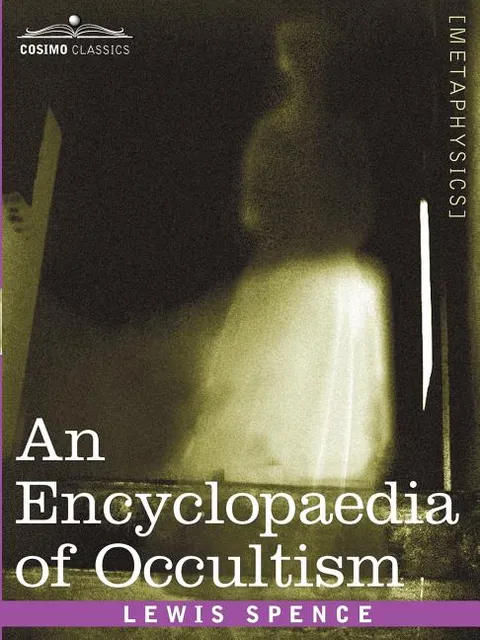
An Encyclopaedia of Occultism
Report an issue
Tell us what's wrong and we'll take a look.
Thanks – we got it. We'll review and follow up if needed.

This "compendium of information on the occult sciences, occult personalities, psychic science, demonology, spiritism, and mysticism" was one of a kind when it was first published in 1920 and is still considered the best in its field today. Spence organizes a world's worth of magic -- from "Ab" (a magical month in the ancient Semitic calendar) to "Zulu witch-finders" -- into 2,500 dictionary-style entries that explore concepts and personalities both familiar (Freemasonry, Morgan le Fay) and obscure: palingenesy (a process by which plants or vegetables are destroyed and then "resurrected"), Leonora Galigai (a 17th-century Italian aristocrat who was burned as a witch). A delight for devotees of the weird and the strange, and a valuable resource for students of mythology and the evolution of scientific thought, this important volume is at home in the libraries of all book lovers. Scottish journalist and folklorist LEWIS SPENCE (1874 -1955) was a Fellow of the Royal Anthropological Institute of Great Britain and Ireland, and Vice-President of the Scottish Anthropological and Folklore Society. He published more than 40 works on mythology and the occult, including History of Atlantis, An Introduction to Mythology, and Myth and Ritual in Dance, Game and Rhyme.
Lewis Spence
James Lewis Thomas Chalmers Spence was born on November 25, 1874, in Monifieth, United Kingdom, to parents James Spence and Margaret Chalmers. He received his education at the University of Edinburgh, where he developed a strong foundation in literature, history, and the study of myth. Throughout his life, he pursued multiple intellectual paths as a journalist, poet, author, folklorist, and scholar of the occult. Spence's fascination with ancient belief systems and comparative mythology led him to publish numerous works exploring Celtic traditions, Atlantis, and spiritual symbolism. He contributed significantly to early 20th-century thought by examining the intersections of folklore, anthropology, and esoteric beliefs. Spence was known for seeking patterns in mythic narratives that connected different civilizations, reflecting his broader interest in cultural continuity and lost knowledge. He became a Fellow of the Royal Anthropological Institute of Great Britain and Ireland and served as vice-president of the Scottish Anthropological and Folklore Society. Beyond his literary and academic achievements, Spence also engaged with political activism, founding the Scottish National Movement and later becoming associated with the Scottish National Party. He died in Edinburgh on March 3, 1955, leaving behind a legacy rich in cultural inquiry and national pride.
More by Lewis Spence



Why Readwise Books?
Readwise Books is an ebook & audiobook platform that automatically logs how much you and your friends read, making it fun and easy to read more. Learn more →