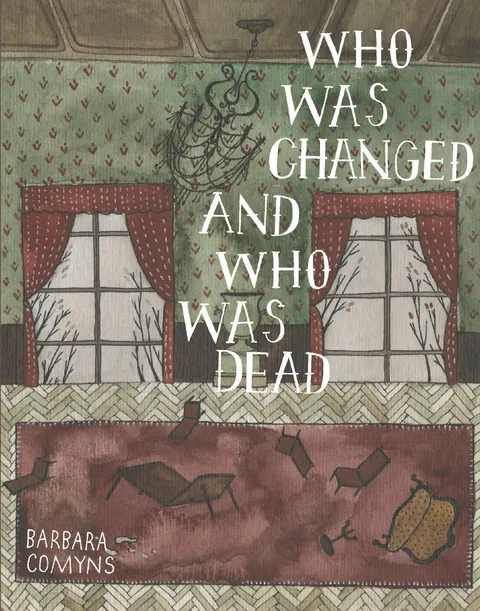
Who Was Changed and Who Was Dead
Report an issue
Tell us what's wrong and we'll take a look.
Thanks – we got it. We'll review and follow up if needed.
A mysterious epidemic strikes an English village in this surreal, irresistible, and darkly funny Barbara Comyns classic, hailed as an “overlooked small masterpiece” (The Rumpus).
“So funny, so exact, so twisted.” —PBS
This is the story of the Willoweed family and the English village in which they live. It begins mid-flood, ducks swimming in the drawing-room windows, “quacking their approval” as they sail around the room. “What about my rose beds?” demands Grandmother Willoweed. Her son shouts down her ear-trumpet that the garden is submerged, dead animals everywhere, she will be lucky to get a bunch.
Then the miller drowns himself . . . then the butcher slits his throat . . . and a series of gruesome deaths plagues the villagers. The newspaper asks, “Who will be smitten by this fatal madness next?”
Through it all, Comyns’ unique voice weaves a text as wonderful as it is horrible, as beautiful as it is cruel. Originally published in England in 1954, this “overlooked small masterpiece” is a twisted, tragicomic gem.
Barbara Comyns
Born in 1909 at Bidford-on-Avon, Barbara Comyns was educated mainly by governesses until she went to art schools in Stratfordupon-Avon and London. She started writing fiction at the age of ten and her first novel, Sisters by a River, was published in 1947. She also worked in an advertising agency, a typewriting bureau, dealt in old cars and antique furniture, bred poodles, converted and let flats, and exhibited pictures in The London Group. She was married first in 1931, to an artist, and for the second time in 1945. With her second husband she lived in Spain for eighteen years. She died in 1992.
More by Barbara Comyns


Why Readwise Books?
Readwise Books is an ebook & audiobook platform that automatically logs how much you and your friends read, making it fun and easy to read more. Learn more →